When the customer presses send

A Commonwealth Bank branch in Crookwell, New South Wales. Across the bank, AI checks more than 20 million payments a day on average to catch scams before money moves.
Photo: Nick-D · CC BY-SA 4.0 · Wikimedia Commons
Imagine a caller who knows your name and your bank balance. Someone is emptying your account, they say, and they can help you move your savings somewhere safe. You sign in on your own phone, type in the details and press send. To the bank, several things look exactly right. It’s your phone. You know the password. In the few seconds before the money leaves, the bank has to spot the one thing that’s wrong: someone has lied to you about where it is going.
| Difference | Authorized scam (AI target) | Unauthorized fraud |
|---|---|---|
| Who initiates | The customer sends the payment under false pretenses. | Someone else makes the payment, often with stolen card details. |
| Window to help | Seconds before money leaves—while funds are still in the sender’s account. | Cardholders can dispute charges after the fact. |
| What works | A real-time warning that gives the customer pause to verify the recipient. | Standard card-dispute and chargeback protections. |
Artificial intelligence (AI) makes the caller’s story easier to sell. A criminal can fake a familiar voice or turn out a polished message in seconds. Commonwealth Bank puts AI on the other side of the call. It looks at where the payment is going and how it fits with earlier activity, even when the sender trusts the voice on the phone. Getting there before the money leaves is hard. 2026 Gartner research found that over one-third of banks detect under 60% of fraudulent transactions before losses occur, and only 31% achieve preemptive detection above 80%.[1]
What the AI can see before money moves
Commonwealth Bank checks more than 20 million payments a day on average. Its AI has learned from past activity what a risky transfer looks like, and it scores each new one before the funds leave the account. Three companion checks work further upstream, catching scams earlier in the conversation.[2]
-
Payment pattern scoring Real time
A large transfer goes to a first-time recipient. That could just be a home renovation. But if the destination resembles accounts used in earlier scams, the AI shows a warning or briefly holds the transfer, while the customer still has time to call the builder.
-
Recipient name matching First-time payees
Does the name the customer typed fit the receiving account details? A fake invoice might carry the builder’s real name over a swapped account number. A customer might mistype a digit. Either way, the warning gives them something specific to check before money moves.
-
In-app card approval Online purchases
Eligible online card purchases get approved inside the mobile app. That cuts reliance on one-time passcodes (OTPs) sent by text, the codes scammers talk customers into reading aloud. Customers see the payment details on their own screen before they approve.[3]
-
AI screenshot scam checker Upstream pilot
A free pilot in a separate identity-protection app. Get a suspicious text, upload a screenshot, and the AI draws on the bank’s scam intelligence to explain what looks off, before anyone clicks the link.
In June 2025 the Bank for International Settlements (BIS) Innovation Hub and the Bank of England reported on Project Hertha. It ran network-level AI payment analytics over 308 million simulated real-time retail transactions across 1.8 million accounts. In the simulation, the analytics helped banks and payment providers find 12% more illicit accounts and do 26% better at spotting novel, previously unseen financial-crime patterns.[4]
How much less customers lost
James Roberts, the bank’s general manager of group fraud, estimated that recipient-name checks prevented tens of millions in scam payments. The same checks spared customers hundreds of millions in accidental wrong-account transfers. Across the year ending June 2024, customers lost half as much to scams as in the previous financial year.[5]
For every A$100 lost to scams at the 2022 peak, customers lost A$24 in the first half of 2025.
76% fall in customer scam losses · Commonwealth Bank (Aug 2025)In August 2025 the bank reported a 76% fall in customer scam losses, comparing January through June 2025 with July through December 2022.[6] AI monitoring, payment checks and other protections did that work together; the screenshot pilot and the new in-app card approvals rolled out after that reporting period. Australia-wide, the Australian Competition and Consumer Commission (ACCC) and National Anti-Scam Centre report that reported scam losses fell 29.7%, from their A$3.1 billion 2022 peak to A$2.18 billion in 2025.[7]
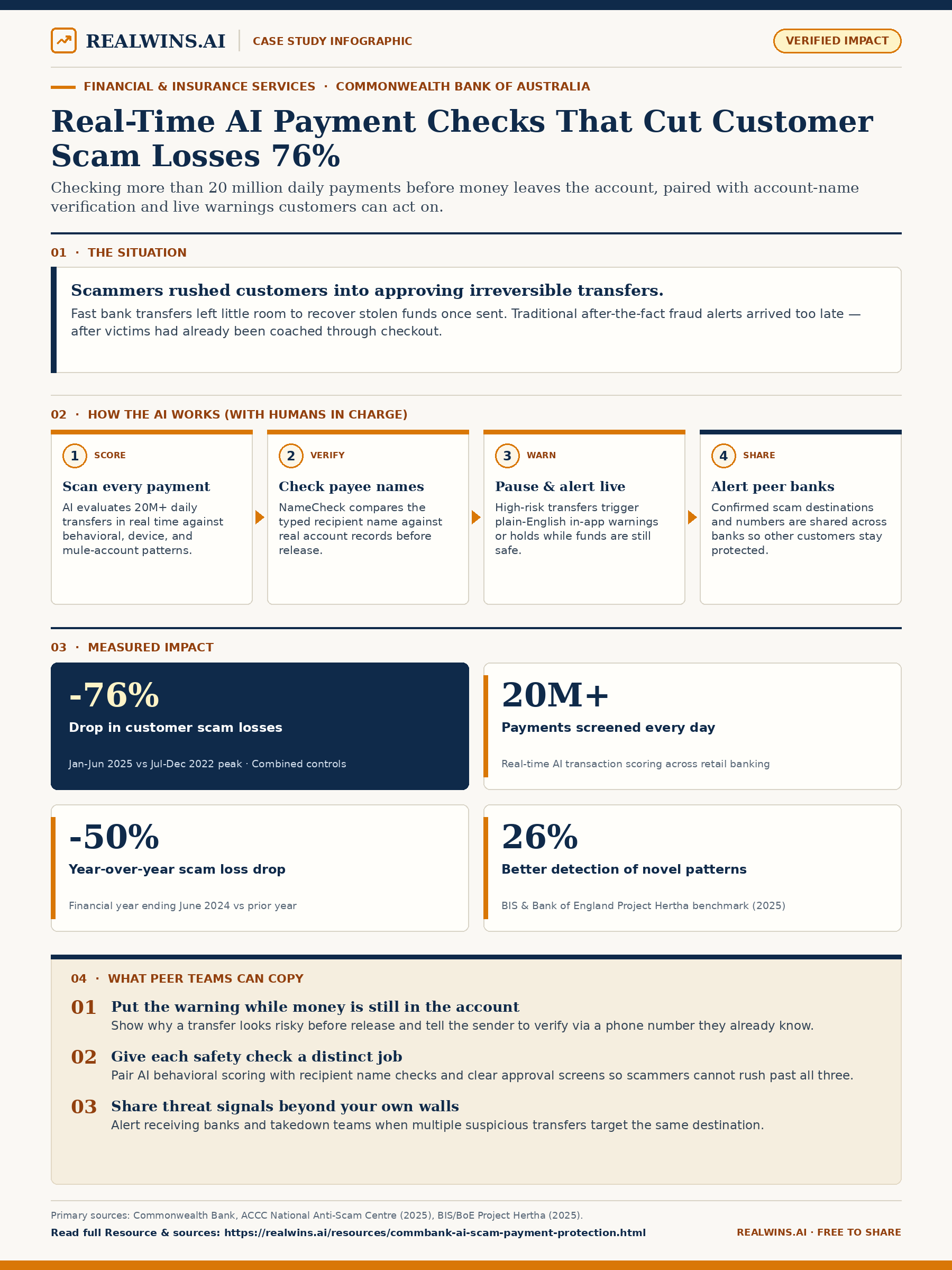
VISUAL INFOGRAPHIC · FREE TO SHARE
Commonwealth Bank Real-Time AI Scam Checks — Visual Summary
A high-resolution, single-page visual summary of how Commonwealth Bank screens 20M+ daily payments, cut customer scam losses 76%, and shares warnings across banks.
How one bank’s warning can reach another bank’s customer
Chief executive Matt Comyn talks about the screenshot checker as part of a bank-wide response that reaches past Commonwealth Bank’s own accounts.[8] Australians can use the identity-protection app even if they bank elsewhere. They get a read on a suspicious text, and the fresh scam links and scripts they upload help keep the AI warnings current.
By August 2024, Commonwealth Bank had opened its recipient-name check to other financial institutions.[9] If two people at two different banks pay the same fake invoice, both can get the mismatch warning. Flagged phone numbers and URLs go out to carriers and platforms, which can block the scam upstream.
Roberts tells customers to call back using the number on their bank card. An AI warning inside the bank’s app buys them the breathing room to do it. That matters because the scammers keep at it: the ACCC, Australia’s national consumer watchdog, collects scam reports through Scamwatch, and national figures cited by the bank put reported phishing losses at A$97.6 million in 2025, up from A$84.5 million in 2024.[10]
Westpac in Australia[11] and NatWest in the United Kingdom[12] both run AI tools against scams: Westpac with real-time monitoring against impersonation scams and payment fraud, NatWest with a tool that routes customers who report a suspicious card transaction.
What peer teams can copy
Four moves for fraud, risk and digital-banking teams building real-time AI scam protection.
Phase 1 · At the Moment of Payment
-
Put the warning where someone can act on it
Customer & FrontlineWhen the AI flags a transfer, say what worried it while the money is still in the account. Then give the sender one concrete step: call a familiar number and check the changed payment details.
-
Give each check a specific job
Governance & RiskAI spots patterns across payments. A name check flags an unexpected destination. An approval screen shows exactly what the customer is authorizing. Each one answers a different question a scam caller might try to rush past.
Phase 2 · Customer Trust & Ecosystem
-
Explain the hold to the person waiting
OperationsWhen a genuine payment gets held, tell the customer how to reach staff and when to expect an update. Track how long those releases take, right beside the losses prevented.
-
Send a warning beyond your own bank
OperationsWhen several suspicious payments point at the same destination, alert the receiving bank. Pass scam numbers and links to the teams that can take them down. The next person has one less dangerous message to spot.
Footnotes & Sources
- Gartner — Banking Fraud Detection & Preemptive Controls Research (2026)
- Retail Banker International — AI checks across daily payments
- Australian Broker — In-app card approvals and text-message checks
- Bank for International Settlements (BIS) Innovation Hub & Bank of England — Project Hertha (June 2025)
- Commonwealth Bank — Scam losses and mistaken payments prevented by NameCheck
- Commonwealth Bank — Peak loss comparison, security spending and the Truyu pilot
- ACCC & National Anti-Scam Centre — Targeting Scams Report (2025)
- The Nightly — Matt Comyn on scam prevention and Truyu
- Open Banking Expo — NameCheck sharing with Bendigo Bank and J.P. Morgan Liink
- Commonwealth Bank — Impersonation warnings and national loss figures
- Westpac — Scam Prevention & AI Protection Measures (April 2026)
- NatWest Group — Next-Generation AI Tools for Customer Fraud Protection (2026)