A great class still moves at one speed
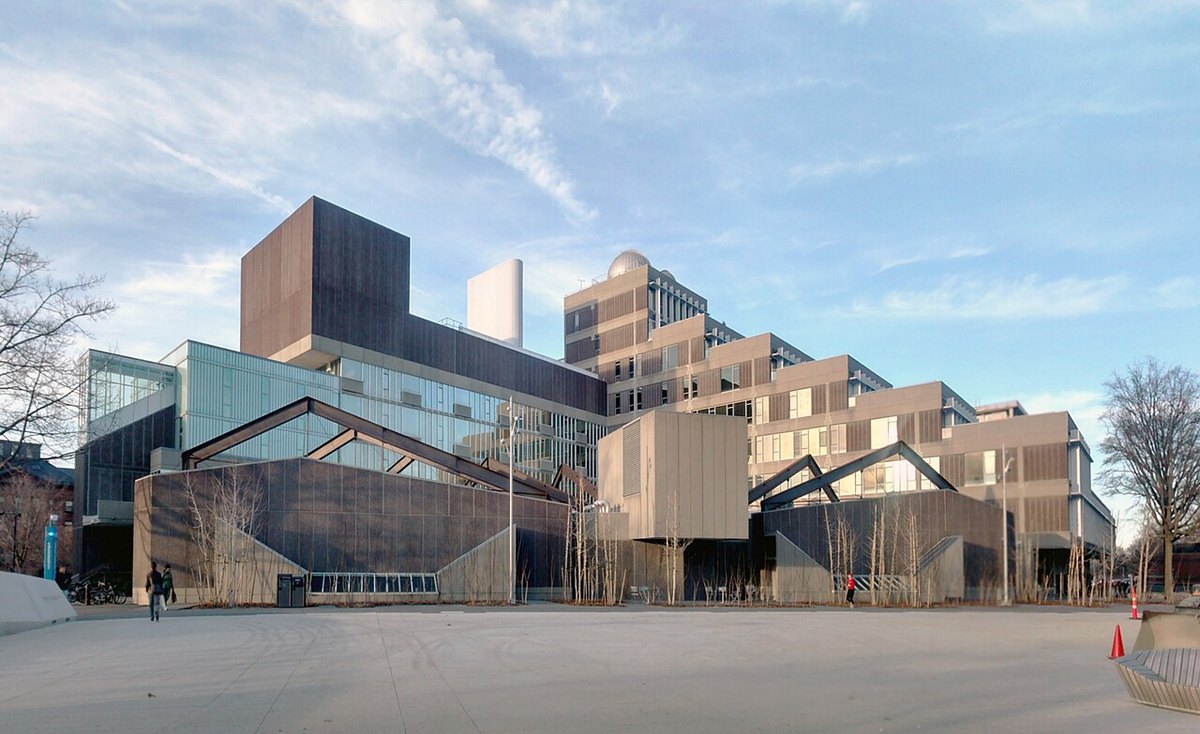
Harvard University’s Science Center in Cambridge, Massachusetts, home to large introductory physics courses including Physical Sciences 2.
Photo: Gunnar Klack (CC BY-SA 4.0), via Wikimedia Commons.
Physical Sciences 2 puts a hundred-plus students in one room to work physics problems together, and the pace is set by the room, not by any one student. This is Harvard’s largest physics course, taken mostly by students headed into the life sciences. It already used active learning, where students work problems with classmates during class instead of listening to a lecture. That method beats lecturing. Even so, a room of more than a hundred moves at one pace, and one instructor cannot give every student instant feedback on the step where they are stuck.
| Lesson feature | AI tutor lesson | Active-learning class |
|---|---|---|
| Pace | Each student sets their own pace | The whole room moves together |
| Feedback | Instant, on the exact step in progress | From classmates and staff walking the room |
| Content | The same problems, grounded in faculty-written answers | The same problems, led by the instructor |
Students already had general chatbots, which will happily hand over a finished answer and skip the thinking. “AI tutors shouldn’t ‘think’ for students, but rather help them build critical thinking skills,” said physics lecturer Greg Kestin.[1] Among UK undergraduates, a Higher Education Policy Institute survey published in February 2025 and fielded in December 2024 asked 1,041 of them about AI. It found 92% used AI tools, up from 66% a year earlier.[2]
A tutor that works from the professors’ own answers
A student asks for help and the tutor is set up to answer with one step at a time. Behind that reply sits PS2 Pal, a course-specific tutor the teaching team built, with instructions written around seven teaching practices: active engagement, managing cognitive load, a growth mindset, scaffolding, accuracy, timely feedback and self-pacing. The team then loaded each lesson’s comprehensive, step-by-step answers written by faculty, so the tutor works from a known-good solution instead of building the physics on its own.[3]
-
Start from the faculty solution Grounded
Every lesson’s instructions carry the teaching team’s own worked answer, so the tutor checks student reasoning against a known-good solution.[3]
-
Guide one step at a time Hints, not answers
The tutor was instructed to give away only one step at a time, never the full solution in a single message, and to keep replies to a few sentences so students are not overloaded.[4]
-
Walk through each part in order Structured
The platform walks students through each part of each problem in sequence. The team built that structure into the software because instructions alone could not guarantee it.[3]
-
Let students set the pace Self-paced
Students work through the material on their own schedule, then bring their questions to class. “This allows for the human interaction to be much richer,” Kestin said.[4]
Two lessons, a clear result
In fall 2023 the team ran a randomized crossover trial: 194 students, two weekly lessons, on surface tension and fluid flow. Each student learned one topic with the AI tutor and the other in the active-learning class. Starting from a pooled pre-test median of 2.75 across 316 observations, the AI group reached a median post-test score of 4.5. The class group reached 3.5. That is more than double the learning gain. The peer-reviewed results appeared in Scientific Reports in June 2025.[3]
Students learned more in less time: the median AI session took 49 minutes, against about an hour of class learning time.
Fall 2023 · Scientific Reports (2025)Hours spent did not predict scores, so extra time does not explain the gains. The authors estimate the effect at between 0.73 and 1.3 standard deviations, a large result for a teaching change.[3]
From one physics course to the wider campus
A section of Math 21a has run with an AI tutor. Harvard Business School’s Financial Reporting and Control course has its own tutor bot. In summer 2025 Harvard University Information Technology introduced two new campus AI tools, HUbot and PingPong.[5] Kestin is working with Harvard’s math department and colleagues at Yale and Stanford on more custom-made tutors. “Students could learn more, and also felt more engaged and motivated,” Kestin said.[6]
A 2025 Inside Higher Ed Student Voice survey of 1,047 students at 166 two- and four-year institutions found 85% had used AI for coursework in the past year.[7] Tyton Partners’ Time for Class 2025 study, a separate survey of more than 3,300 respondents, found weekly AI use among 42% of students and 30% of instructors.[8]
The University of California San Diego is piloting a similar tutor for a genetics course of nearly 400 students. Trained on the course materials, it takes a Socratic approach and prompts students to work through concepts instead of supplying answers.[9]
What peer instructors can copy
Four practical moves for faculty, course designers and teaching centers building a course-specific AI tutor.
Phase 1 · Build the Tutor Around Your Course
-
Give the tutor your own worked solutions
AI & Workflow DesignLoad the step-by-step answers your teaching team already trusts, so the tutor checks reasoning against them instead of improvising the physics.
-
Write the teaching rules down
Governance & RiskTell the tutor to reveal one step at a time, keep replies short and encourage effort. Build in the structure software can enforce, such as working through each part in order.
Phase 2 · Test It Like a Teaching Change
-
Compare against your best class, not a lecture
Data & MeasurementUse a crossover design so every student tries both formats, and measure pre- and post-test scores, time on task and engagement for the same lessons.
-
Use class time for what people do best
Human OversightLet the tutor prepare students before class, then spend class time on deeper discussion and the questions it surfaces, with instructors firmly in charge.
Footnotes & Sources
- Harvard Gazette — Professor tailored AI tutor to physics course. Engagement doubled. (September 2024)
- Higher Education Policy Institute — Student Generative AI Survey 2025, Policy Note 61 (February 2025)
- Kestin, Miller et al. — “AI tutoring outperforms in-class active learning: an RCT introducing a novel research-based design in an authentic educational setting,” Scientific Reports 15, 17458 (June 2025)
- The Hechinger Report — Proof Points: An AI tutor helped Harvard students learn more physics in less time (September 2024)
- Harvard Gazette — What if AI could help students learn, not just do assignments for them? (October 2025)
- GBH News — With AI common on campus, some educators are leaning in (September 2025)
- Inside Higher Ed — How AI Is Changing—Not ‘Killing’—College, Student Voice survey (August 2025)
- Tyton Partners — Time for Class 2025 (June 2025)
- University of California — What does it mean to learn with AI? (April 2026)