When a crowd arrives faster than the network can react
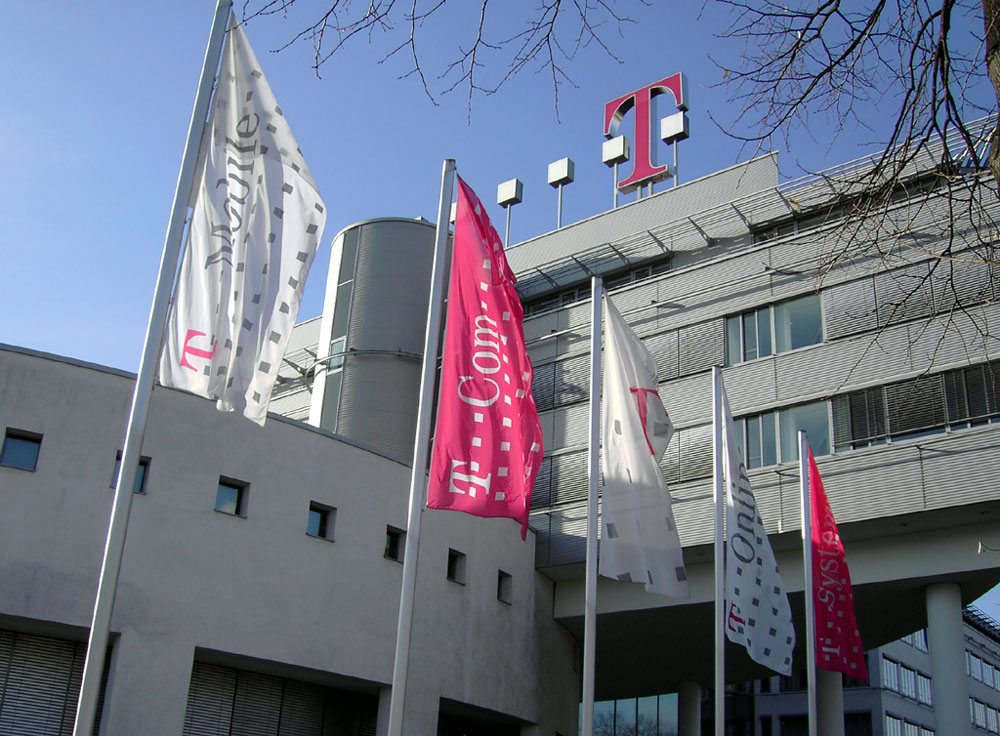
Deutsche Telekom’s headquarters in Bonn, Germany, overseeing nationwide mobile network operations.
Photo: Qualle (CC BY-SA 3.0), via Wikimedia Commons.
A Christmas market or a carnival weekend can push a sudden surge of load onto the nearby mobile cells. Under the old way of working, Deutsche Telekom says, fixing a surge like that could take roughly an hour of manual analysis and setting changes.[1]
| Difference | Manual fix | AI-assisted fix |
|---|---|---|
| Time to act | Hours of analysis and setting changes | About one minute for a major event, per the company |
| Who decides | Engineers work out each change by hand | Employees set goals, review results and keep responsibility for decisions |
| Record of changes | Depends on the engineer’s notes | Every action and outcome is logged for review |
Across the industry, operators have mostly pointed AI at cutting costs. Just 16% of AI deployments target network use cases, according to GSMA Intelligence data cited by the GSMA, even though networks make up 34% of operator operating costs.[2] A separate GSMA Intelligence study from late 2025 found that money-saving rollouts still make up the bulk of deployments.[3]
Software that spots the event and adjusts the network
The work is done by AI agents: software that waits for a trigger and then acts on its own, within limits. Deutsche Telekom’s network agent, the RAN Guardian Agent, works the radio access network, the part that links phones to towers. For 2026 it has identified 237,000 events.[4]
-
Spot the event Event scan
The system reads the calendar of upcoming public events across Germany and watches for sudden traffic spikes. Each one gets tied to the mobile cells covering that spot.
-
Check the likely impact Impact check
Before touching a setting, the agent checks the nearby antennas and the live network readings. The fix has to match the load that is actually building.
-
Adjust, and keep people in charge Remediation
Selected fixes run on their own. Employees set the goals, review the results and keep responsibility for the decisions. Every action and outcome goes on the record.[5]
-
Learn from the result Feedback
Each outcome is saved for the next event, so the system gets better at handling the peaks to come.
Abdu Mudesir, the board member who leads product and technology at Deutsche Telekom, called the November 2025 launch a first: a network operator relying on a highly developed AI agent in network management.[6]
From hours of manual work to about one minute
In its first month after launch, the system triggered over 100 remediation actions on its own. Major events that used to take hours now take about a minute to manage, which the company puts at a more than 95% improvement.[7]
A fix that once took hours now takes about a minute for major events.
More than 95% faster · Deutsche Telekom (Feb 2026), company-reportedGermany went first. The system is now being extended across the group’s European national companies, starting with the Czech Republic and Croatia, Deutsche Telekom said in February 2026.[8]
How the same method can travel to other operators
Deutsche Telekom’s leaders have a name for where this is heading: autonomous, self-healing networks. These are systems that find and fix their own capacity problems while people set the rules and review the outcomes.[9] Vodafone is building multi-year programmes to move its networks from single AI tools toward systems that manage more of their own operations.[10] Telefónica reports that it closed 2025 with 12 use cases at the fourth of five autonomy levels, driven by joint work in Spain, Brazil and Germany.[11]
Every automated change goes in the log. After each event, teams can see what the system did and why.[12]
Watch the calendar and the load. Act within agreed limits. Keep a record people can check.
What peer network teams can copy
Four moves for network operations and capacity teams bringing in event-driven AI.
Phase 1 · Before the Crowd Arrives
-
Feed capacity plans from the event calendar
IT & EngineeringTie known public events to the cells that serve them. The network can get ready before the first surge, well ahead of any complaints.
-
Set the limits before the system acts
OperationsDecide in advance which changes the system may make alone and which need a person’s sign-off. Write those limits down.
Phase 2 · People, Records & Rollout
-
Name who owns each decision
Governance & RiskName the staff who set the goals, review each outcome and answer for the result. Automation should never leave a gap in accountability.
-
Expand one market at a time
Rollout & AdoptionProve it in one market, then extend it as the results hold. The group is moving from Germany to the Czech Republic and Croatia.
Footnotes & Sources
- Deutsche Telekom — AI agents for the mobile network (Nov 2025)
- GSMA — Scaling Telco AI from Ambition to Reality (June 24, 2026)
- GSMA Intelligence — Telco AI: State of the Market, Q3 2025 (Oct 2025)
- Deutsche Telekom and Google Cloud — AI agents in the network (Feb 2026)
- Deutsche Telekom — Boosts growth, efficiency and quality through AI (Oct 2026)
- Deutsche Telekom — AI agents for the mobile network (Nov 2025)
- Deutsche Telekom and Google Cloud — AI agents in the network (Feb 2026)
- Deutsche Telekom and Google Cloud — AI agents in the network (Feb 2026)
- Deutsche Telekom and Google Cloud — AI agents in the network (Feb 2026)
- Vodafone — From connected to intelligent: How AI is transforming Vodafone’s network (Oct 20, 2026)
- Telefónica — Accelerates its transformation to autonomous networks (Feb 18, 2026)
- Deutsche Telekom — AI agents for the mobile network (Nov 2025)