A stopped machine offshore can stop production
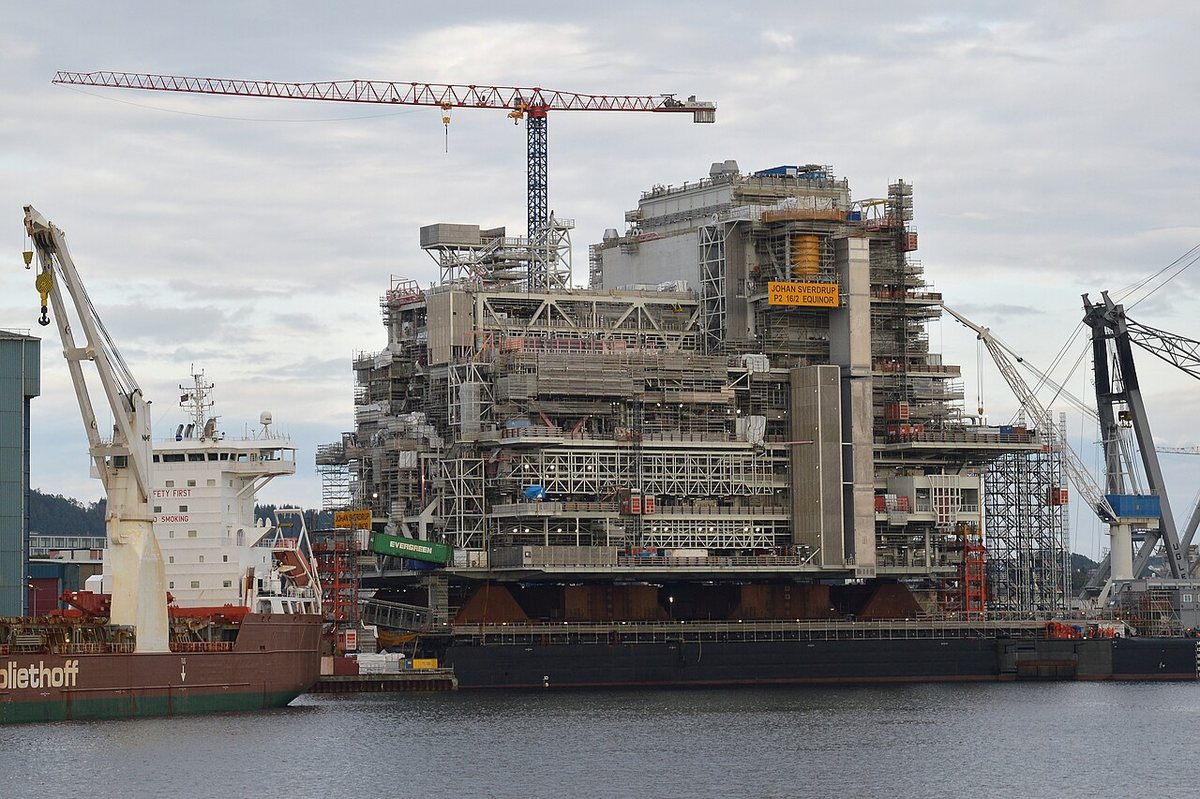
Equinor’s Johan Sverdrup P2 offshore platform topsides in Norway, where continuous sensor monitoring protects rotating machinery.
Photo: Ryan Hodnett (CC BY-SA 4.0), via Wikimedia Commons.
When a compressor on an offshore platform trips, whatever production runs through it can stop with it. Fixing it means getting people and parts out to the site, and every hour the machine sits idle, the cost of waiting grows. Pumps and turbines carry the same risk. Equinor uses AI to predict when machines need maintenance and cut the risk of shutdowns.
Spotting the wear before the breakdown is one of the main jobs AI does in oil and gas. The International Energy Agency’s 2025 Energy and AI report puts predictive maintenance on its list of main uses, alongside subsurface data processing (interpreting underground seismic readings), reservoir simulation (modeling how oil and gas flow underground) and remote operations.[1]
| Difference | Reactive repair | Predictive monitoring |
|---|---|---|
| When a fault is found | After the machine has stopped | From early warning signs, before failure |
| How work is planned | Crews respond to the alarm | Crews schedule the job into a planned window |
| What it covers | Machines that have already caused trouble | Every monitored rotating machine, all facilities |
Equinor watches more than 700 rotating machines across all of its facilities, through 24,000 sensors.[2]
Sensors feed AI that flags trouble early
Readings from all 24,000 sensors flow into a monitoring system built for predictive maintenance. Its job is to give crews time to act before a machine trips.[3]
-
Sensors report continuously Continuous data
Every monitored machine streams its readings into one central system.
-
Early warnings flagged Early warning
The AI hunts for readings that point to a fault taking shape. Crews get the warning while there’s still time to act.
-
Work planned into windows Planned work
The repair goes into a planned maintenance window instead of an emergency callout. That’s where the savings come from.
-
Field design improved Project design
Equinor points the same kind of AI at project planning. On Johan Sverdrup Phase 3 it turned up a solution no one had considered, saving the partnership $12 million.[4]
Then there’s the seismic data. In 2025 Equinor’s AI tool helped interpret 2 million square kilometers of it, with a tenfold increase in interpretation capacity, the company reports.[5]
Savings across maintenance, subsurface and projects
AI contributed $130 million in value creation and savings for Equinor and its partners in 2025, the company reports. Since 2020, the total is more than $330 million.[6]
In 2025 alone, AI delivered about 39% of the value Equinor reports since 2020.
Value and savings for Equinor and partners · Equinor news release (Jan 7, 2026)Predictive maintenance has delivered $120 million in value since 2020, counted across those years together. The $130 million covers 2025 alone, for the company and its partners.[7]
Where other energy operators are going
Equinor aims its AI at the calls that matter most offshore. When does this machine come down for maintenance? Which field-development option goes ahead? How fast can the seismic be read? The results it reports span all of its facilities.
At TotalEnergies, the RAID remote assistance and diagnostics team keeps a similar remote watch, continuously analyzing data from more than 33,000 sensors.[8]
More than 700 rotating machines, across every one of Equinor’s facilities, sit under the AI’s watch.[9]
Put sensors on the machines that matter. Warn early. Schedule the work.
What industrial teams can copy
Four moves for maintenance, asset and project teams bringing in predictive monitoring.
Phase 1 · Choose Where to Start
-
Begin with the machines whose stop costs most
OperationsRank your rotating machines by what a stoppage would halt. Wire up the top of that list first.
-
Map sensor coverage before trusting the warnings
OperationsWalk the plant and find where readings are missing. The warning system can’t afford blind spots at the assets that matter most.
Phase 2 · Turn Warnings Into Planned Work
-
Schedule each fix into a planned window
AI & Workflow DesignSlot each flagged repair into a planned window. Crews, parts and access are lined up before the job starts.
-
Report value for partners as well as the owner
Data & MeasurementWhen a project has several partners, count the savings for all of them. Equinor reports for itself and its partners, which keeps the case for AI a shared one.
Footnotes & Sources
- International Energy Agency — Energy and AI, chapter “AI for energy optimisation and innovation” (2025)
- Equinor — Use of artificial intelligence saved Equinor USD 130 million in 2025 (Jan 7, 2026)
- Equinor — Use of artificial intelligence saved Equinor USD 130 million in 2025 (Jan 7, 2026)
- Equinor — Use of artificial intelligence saved Equinor USD 130 million in 2025 (Jan 7, 2026)
- Equinor — Use of artificial intelligence saved Equinor USD 130 million in 2025 (Jan 7, 2026)
- Equinor — Use of artificial intelligence saved Equinor USD 130 million in 2025 (Jan 7, 2026)
- Equinor — Use of artificial intelligence saved Equinor USD 130 million in 2025 (Jan 7, 2026)
- TotalEnergies — Predictive Maintenance: TotalEnergies RAID at the forefront (Feb 27, 2026)
- Equinor — Use of artificial intelligence saved Equinor USD 130 million in 2025 (Jan 7, 2026)