The Problem: Good Food Thrown Away Before Anyone Ate It
A tray of food sits under a heat lamp too long. Now picture that in the restaurants, bistros and Swedish food markets inside more than 400 IKEA stores worldwide. IKEA is famous for flat-pack furniture, but it is also one of the world’s biggest restaurant operators. Ingka Group, the company that owns and runs most IKEA stores, serves hundreds of millions of diners every year.
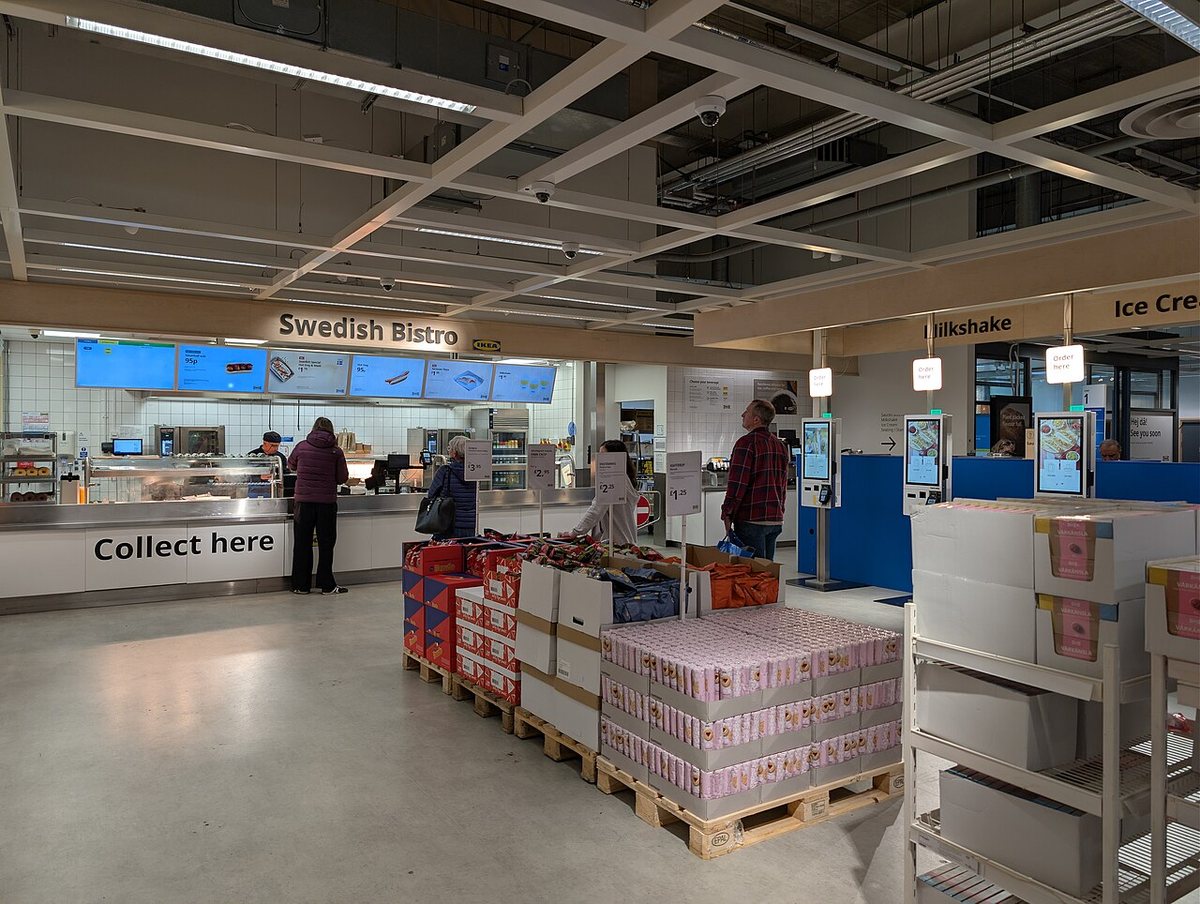
The Swedish Bistro counter at IKEA Southampton. Bistros, restaurants and food markets like this one are part of the in-store food operations behind IKEA’s kitchen food-waste tracking.
Photo: Andy Li · CC0 1.0 Public Domain · Wikimedia Commons
Every busy commercial kitchen ends up with food that never reaches a plate: meatballs left too long under the heat lamps, prep batches that expired before the lunch rush, serving-counter leftovers at closing time. Chefs call this “production waste”: food that was bought, prepared, and often cooked, but never sold. The scale is global. The UN Environment Programme’s 2024 Food Waste Index Report estimated 1.05 billion tonnes of food wasted worldwide in 2022 (about 19% of food available to consumers), with commercial food service accounting for 28%, roughly 290 million tonnes a year.[1]
| Dimension | Busy shift, no station | Scale at the bin |
|---|---|---|
| Recording a leftover | Hard to stop and write down in the middle of a lunch rush. | Same motion as clearing the counter—no separate trip. |
| Details captured | Difficult to note while the counter is busy. | The dish, its weight and the time of day. |
| Where data is collected | Separate from clearing the counter. | Where the work already happens. |
A lunch shift is a good time to spot a pattern and a hard time to write it down. When a cook trims a batch or clears a serving tray, the useful details are the dish, its weight and the time of day. IKEA wanted to capture those where the work already happened. A scale at the bin let cooks record leftovers in the same motion they used to clear the counter.
How IKEA’s AI Scales See and Weigh Every Scrap
In 2017, under a company-wide program called “Food is Precious,” IKEA began installing AI-powered waste stations in its kitchens, built with an outside commercial-kitchen technology partner. Each station is simple: a digital scale under the kitchen’s waste bin, a small camera mounted above it, and a touchscreen. By Ingka’s 2024 and 2025 financial years, the stations were running in between 402 and 429 stores around the world.
Follow one shift, starting the moment a cook scrapes leftover mashed potatoes into the bin.
-
Weigh and photograph At the bin
The scale records the exact weight while the overhead camera snaps a photo.
-
Recognize the dish Image recognition
Computer-vision AI, software trained on huge numbers of food photos to recognize what it is looking at, much as your phone recognizes faces in your photo library, identifies the dish automatically.
-
Price it and log it In seconds
The system works out what that food cost to make and how much greenhouse gas pollution producing it created, then logs the entry in seconds. Staff type almost nothing; at most they confirm the AI’s guess with a tap.
-
Review the ranking Every morning
The second half of the system is what managers do with that record. Each morning, kitchen leads open a plain dashboard that ranks the most-wasted items by shift and by day of the week. If Tuesday afternoon’s salmon keeps ending up in the bin, the team cooks smaller batches more often, adjusts prep quantities, or finds new uses for trimmings.
The camera earns its keep when several dishes pass through a station during the lunch rush. A scale alone records the weight of a tray of leftovers. The camera tells the kitchen lead which dishes make up that weight and ties each entry to the cost of its ingredients. If the camera’s guess needs a correction, the cook confirms it on the screen and gets back to service. With a price on every entry, a kitchen lead can pick the first change to try and check at the next service whether it worked. A 2025 peer-reviewed study in Frontiers in Artificial Intelligence examined how commercial hospitality kitchens use automated, real-time AI food-waste recognition and demand forecasting to cut kitchen waste and save costs where manual logging falls short.[2]
The AI-Driven Results—and How Other Kitchens Compare
Within roughly four years of the first installations, participating IKEA stores had cut kitchen food waste by 54%, saving more than 20 million meals.[3] That made Ingka Group the first major global company recognized by the World Resources Institute—an independent environmental research organization—and its Champions 12.3 coalition of business and government leaders for meeting a United Nations target to cut food waste in half by 2030, years ahead of the deadline.[4][5] The technology partner estimated that the reduction avoided roughly 36,000 metric tons of greenhouse gas emissions a year and saved about $37 million a year in food costs.[6]
Ingka kept tracking the kitchens after the halfway mark. Its 2024 and 2025 annual reports measure kitchen waste in grams per meal served, a measure that stays comparable as restaurants get busier, and show cuts of 60% and 60.5% compared with the 2017 starting point.[7][8]
Measured per meal served, IKEA kitchens now throw away about 60% less food than at the 2017 starting point.
Ingka Group · FY24 & FY25 annual reportsSome hospitality businesses push the AI earlier, before cooking even starts. Hilton paired waste-tracking AI with AI demand forecasting, software that predicts how many guests will come to breakfast and what they will eat. One Hilton hotel in Budapest cut leftover food by up to 69% while its breakfast guest-satisfaction scores rose.[9] Cruise lines face a tougher version of the problem, because a ship in mid-ocean cannot simply restock. Carnival Corporation, a fellow Champions 12.3 member, combined food-waste tracking with demand analysis across its fleet and cut food waste per person by nearly 47%.[10]
Near closing time, IKEA shoppers see the most visible sign of this work. Food the store can no longer sell is packed into “surprise bags” offered at a fraction of the usual price through a third-party surplus-food rescue app.[11] The bags are a useful safety net, and a second line of defense. AI-guided kitchens now cook much closer to real demand, so there is less surplus to rescue in the first place.
The Larger AI Strategy: Sustainability That Pays for Itself
Ingka Group has reported cutting its overall climate footprint by 30.1% while still growing the business.[12] CEO Jesper Brodin and Chief Sustainability Officer Karen Pflug present sustainability as an economic operating discipline, with lower waste and lower emissions helping to fund lower everyday prices for shoppers, and the kitchen work fits that approach.[13]
Every kilogram of food not wasted is food nobody had to buy, ship, cook or haul away. AI added scale: kitchen leads in hundreds of stores use the same measurement and still adjust the dishes and batches that matter in their own restaurants.
Prevention comes first; a second layer handles unsold food in stores. Ingka grew its surplus-food rescue bags from 141,862 in its 2024 financial year to 213,528 across 13 countries in 2025, passing one million bags across its wider program. The sequence matters: use AI to cook less surplus first, then rescue what remains.
Beyond IKEA, the World Resources Institute’s “10x20x30” initiative is encouraging large food retailers to push the same measure-first discipline back up their supply chains to the farms and factories that supply them.
Compass Group reported an 11% year-over-year reduction in North American kitchen food waste using its own food-waste tracking platform,[14] and Sodexo is scaling a food-waste measurement program across client kitchens.[15] Both foodservice peers rely on measuring waste to curb it in commercial kitchens.
What Peer Teams Can Copy
Four practical moves for restaurant, catering and hospitality kitchens using AI to measure and cut food waste.
Phase 1 · Measure at the Bin
-
Collect the data where staff do the work
IT & EngineeringIKEA paired its scale with a camera at the bin. A cook can clear a tray and record the dish and its weight in one trip, even in the middle of service.
-
Turn AI logs into a money conversation every morning
IT & EngineeringRaw weights rarely change behavior. Ranking the top wasted dishes by shift, with a cost attached, gives managers a short, concrete list to act on before the next service.
Phase 2 · Compare & Rescue
-
Measure waste per meal served
Data & MeasurementDivide kitchen waste by the number of meals served in the same period. A manager can then compare a busy Saturday with a quiet Tuesday and see which shift made better use of its ingredients.
-
Pair AI prevention with surplus rescue
AI & Workflow DesignUse AI to cook closer to real demand first, then send whatever is left to a food-rescue channel—prevention cuts the cost, rescue catches the rest.
Footnotes & Sources
- UN Environment Programme (UNEP) — Food Waste Index Report 2024
- Frontiers in Artificial Intelligence — AI-Driven Food Waste Management Strategies in the Hospitality Industry (2025; discusses Leanpath, Winnow and Kitro)
- Ingka Group — IKEA Stores Halve Production Food Waste, Saving More Than 20 Million Meals
- World Resources Institute — IKEA Becomes First Global Company to Halve Food Waste
- Champions 12.3 — First Global Company Halves Food Waste, Showing UN Target Is Achievable
- Winnow — IKEA Becomes First Global Company to Halve Food Waste (Technology Partner: Winnow Vision)
- Ingka Group — FY24 Annual Summary & Sustainability Report
- Ingka Group — FY25 Annual Summary & Sustainability Report
- Sustainable Food Business — Hilton AI Forecasting Cuts Leftover Food (Technology Partner: Winnow Foresight)
- Champions 12.3 — Case Study: How Carnival Corporation Cut Food Waste 47% on Cruise Ships
- Ingka Group — One Million Bags of Leftovers (Surplus Food Rescue Partner: Too Good To Go)
- Ingka Group — Climate Footprint Down 30.1% While Growing the Business
- Sustainability Magazine — What Ingka’s Annual Report Says About IKEA Sustainability
- Compass Group — Stop Food Waste Day 2026 Progress (Waste Not 2.0 & AI Kitchen Tracking)
- Sodexo — Client Food Waste Reduction Partnerships and WasteWatch Program (2026)