The Problem: Paperwork Pulling Doctors Away From Patients
The patient walks out the door. The doctor’s work on that visit continues. For every visit, the physician must write a formal medical visit note—an official record summarizing your symptoms, exam findings, diagnosis, prescriptions, and follow-up plan—inside the health system’s electronic health record (EHR) software, the digital filing system that holds every patient’s medical history.
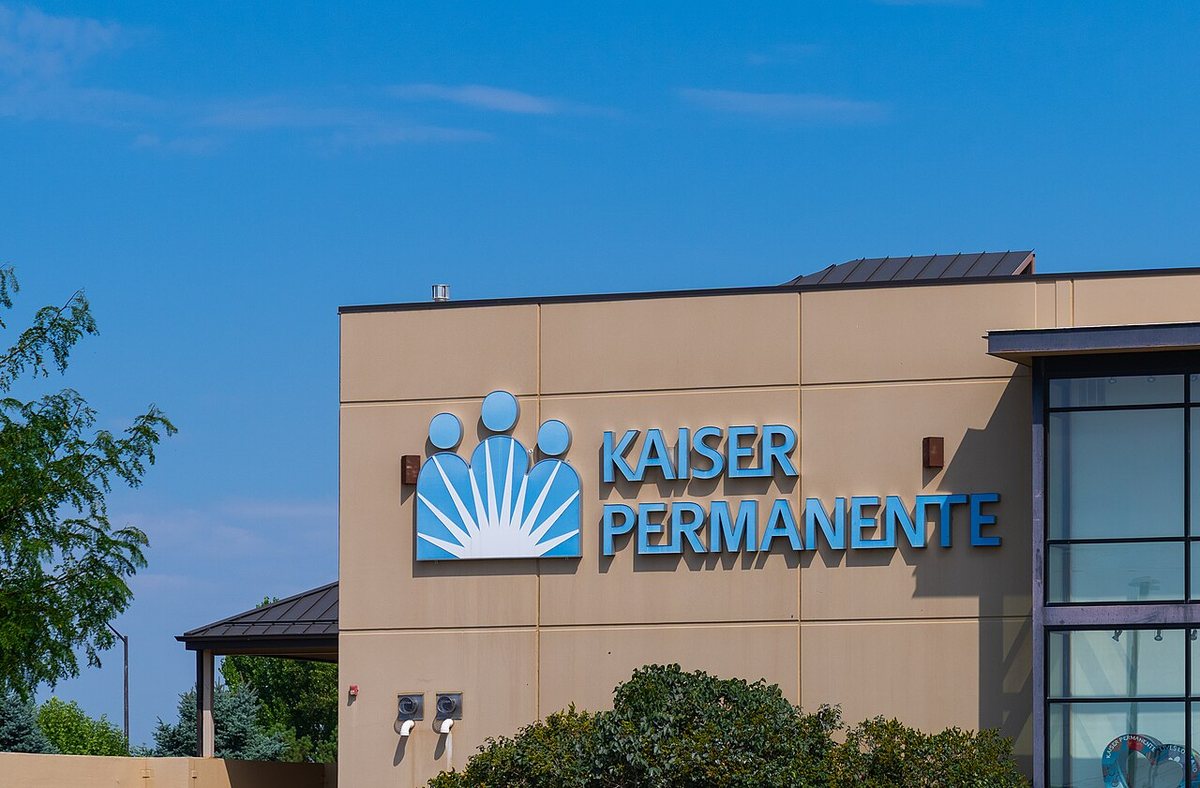
A Kaiser Permanente medical office in Johnstown, Colorado, one of the health system’s more than 600 medical offices. Every visit at offices like this one ends with a formal note for the patient’s record.
Photo: Tony Webster · CC BY 2.0 · Wikimedia Commons
Across Kaiser Permanente’s 40 hospitals and more than 600 medical offices, those notes took up a substantial part of a physician’s day.[1] A doctor could type during an appointment or set time aside afterward to write up the conversation. Some finished charts at home in the evening, in what clinicians call “pajama time.” Drafting the note during the visit offered a way to hand some of that time back.
| Dimension | Typed by the doctor | Drafted by AI |
|---|---|---|
| When the note gets written | During the appointment, afterward, or at home in the evening (“pajama time”). | During the conversation itself—a draft is ready within seconds. |
| What the tools do | Templates and dictation help the doctor enter information. | AI organizes what patient and doctor already discussed into a structured draft. |
| Final sign-off | The physician writes and signs the note. | The physician reviews, edits and signs every draft. |
Templates and dictation helped doctors enter information. The next step was to organize what patient and doctor had already discussed into a draft the physician could review. Kaiser built that step into the appointment itself.
How Kaiser’s Background AI Works Inside the Exam Room
Before the visit starts, the doctor asks the patient’s permission to let the AI listen. Then the conversation goes on as normal while the AI runs quietly in the background. That is Kaiser Permanente’s background AI note-taking software, built with an outside healthcare AI partner. Nobody types a prompt or dictates a command.
-
Ask the patient first Before the visit
Before the visit begins, the doctor asks the patient for permission to let the AI software listen. A patient who prefers no AI gets the traditional approach: the doctor simply takes notes.
-
Listen to the conversation During the visit
When the patient agrees, the AI app listens to the live conversation between doctor and patient.
-
Keep only the medical facts Filtering
The AI filters out everyday small talk—questions about traffic, family, or weekend plans—and pulls out the medically important facts: symptoms, health history, exam findings, diagnoses, and next steps.
-
Draft the visit summary Within seconds
Within seconds, the AI turns those facts into a clean, structured draft visit summary right inside the hospital’s medical-record software.
Kaiser built strict human safeguards around the AI from day one. The AI never makes a medical diagnosis or treatment decision on its own.[2] A licensed doctor must review, edit, and sign every AI-drafted summary before it becomes part of the official patient record, and the system discards the raw audio recording once the draft is created.[3][4] The rollout was gradual. At the HIMSS25 healthcare technology conference, Dr. Brian Hoberman (Executive Vice President of IT and Chief Information Officer of The Permanente Federation) and Dr. Vincent Liu (Chief Data Officer of The Permanente Medical Group) explained that Kaiser first ran a disciplined 10-week quality-check pilot. Doctors across specialties tested the accuracy of the AI-drafted visit summaries and flagged subtle wording errors. Only then did Kaiser expand the rollout across primary care, emergency medicine, mental health, cardiology, and allergy.
Once basic note drafting proved reliable, Kaiser and its AI software partner added a second layer. During an appointment, this feature listens for mentions of ongoing health conditions, such as diabetes or heart disease, and alerts the doctor to standardized medical diagnosis codes (used across healthcare to classify illnesses and coordinate care). The doctor still checks that the visit covered the standard clinical proof, that the doctor monitored, evaluated, assessed, or treated that condition during the appointment, so the AI never adds an old diagnosis automatically.
The AI-Driven Results—and What Real Doctors and Patients Said
Kaiser Permanente’s physicians published peer-reviewed results in a medical journal.[5][6] Over a 15-month period, The Permanente Medical Group tracked AI note-taking across roughly 2.5 million consented patient appointments in Northern California. Researchers compared computer logs of doctors using the AI with those who did not and estimated that the AI saved 15,791 hours of doctor paperwork over one year: nearly 16,000 hours, or roughly 2,000 full eight-hour workdays. Several individual physicians interviewed by the American Medical Association said the AI gave them back roughly an hour a day at the keyboard.[7]
AI note-taking saved an estimated 15,791 hours of doctor paperwork—roughly 2,000 full eight-hour workdays.
The Permanente Medical Group · 15-month evaluationInside the exam room, 84% of participating doctors reported in clinician surveys that using the AI improved their communication with patients.[8] In a companion survey of 118 patients whose appointments used the AI note-taker, 47% noticed their doctor spent less time staring at a computer screen, and roughly two-thirds said they felt fully comfortable with the AI listening once asked for permission.
A separate five-hospital study published in JAMA measured how physicians spent an eight-hour shift. Doctors using background note-taking tools spent 13.4 fewer minutes in medical-record software and 16 fewer minutes writing notes.[9] The two studies came at the work from different angles. Kaiser’s evaluation estimated time saved across millions of visits, while the five-hospital team followed the minutes a doctor spent on documentation during a shift. An August 2025 multi-system study in JAMA Network Open covering 1,430 clinicians found that burnout at Mass General Brigham dropped from 52.6% to 30.7% at 84 days, while clinicians at Emory Healthcare reporting a positive well-being impact from their documentation rose from 1.6% to 32.3%.[10]
Patients described the view from the other side of the desk. In a public discussion, Kaiser patients and a nurse welcomed the chance to make eye contact with a physician during a visit.[11] The doctor can listen while the patient describes a symptom, then check the wording of the note before signing it.
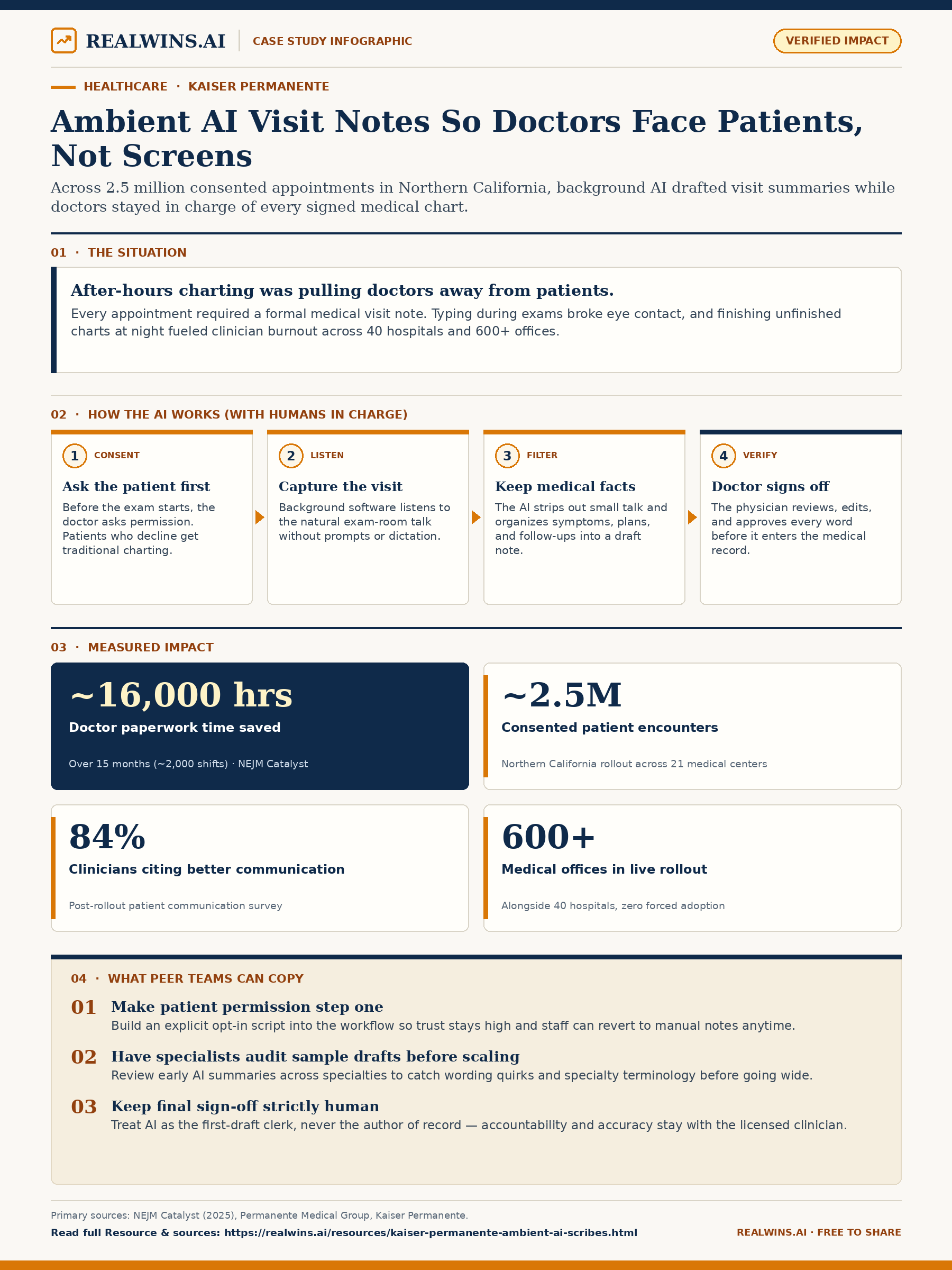
VISUAL INFOGRAPHIC · FREE TO SHARE
Kaiser Permanente Ambient AI Visit Notes — Visual Summary
A high-resolution, single-page visual summary of how Kaiser Permanente’s background AI works across 2.5 million appointments, its verified results, and the three-step clinical playbook.
The Larger AI Strategy Behind the Rollout
Under CEO Greg Adams, Kaiser is expanding its integrated value-based care model (a healthcare approach focused on keeping patients healthy over the long term rather than billing separately for every individual test or visit) across the country through a new organization called Risant Health, which already includes Geisinger and Cone Health,[12] alongside a separate northern Nevada joint venture with Renown Health.[13]
Together, Kaiser Permanente and Risant Health reported $127.7 billion in combined operating revenue in 2025. Drafting a note during the conversation gives doctors more time with each patient as Kaiser brings that model of care to more communities.
Kaiser applies the same disciplined, evidence-first AI testing beyond exam-room note-taking. Through its Northern California Division of Research, Dr. Vincent Liu leads the national Augmented Intelligence in Medicine and Healthcare Initiative (AIM-HI), funded by the Gordon and Betty Moore Foundation.[14] AIM-HI funds real-world clinical trials of diagnostic AI inside working hospitals, including a Cedars-Sinai study testing whether AI can scan routine heart ultrasounds (echocardiograms) to catch early warning signs of cardiac amyloidosis, a serious heart condition doctors can easily miss.[15]
An April 2026 American Hospital Association market scan documented rapid adoption across six major health systems using AI visit-note tools to reduce physician after-hours charting and restore clinician focus during visits.[16] Peer systems including Mass General Brigham and Emory Healthcare,[10] Sutter Health (where 93% of surveyed doctors reported being able to give patients their full attention),[17] and Cleveland Clinic[16] are rolling out AI visit-note drafting across thousands of outpatient clinicians.
What Peer Teams Can Copy
Four practical moves for health systems and clinical teams bringing AI note drafting into the exam room.
Phase 1 · Pilot With Safeguards
-
Run a structured AI quality pilot before scaling wide
IT & EngineeringKaiser’s 10-week pre-rollout pilot had specialists review sample AI-drafted visit summaries and catch subtle wording mistakes before turning the tool on across 600+ clinics.
-
Keep humans on the final sign-off—and be transparent about AI
Governance & RiskTell patients what the software will do and ask for permission before it starts. Give the physician time to check the draft while the details of the visit are fresh.
Phase 2 · Measure & Scale
-
Measure human experience alongside hours saved
Data & MeasurementHours saved on software logs matter, but Kaiser’s biggest adoption win came from asking whether the AI actually improved doctor-patient communication and cut time spent staring at a screen.
-
Choose a task that repeats at every site
Rollout & AdoptionA patient visit in a medical office and one in a hospital both need a signed note. Kaiser could extend the same review process across specialties while letting each doctor decide how to describe the encounter.
Footnotes & Sources
- Kaiser Permanente — Official Rollout Announcement (Technology Partner: Abridge; Care Signals)
- Kaiser Permanente — Seven Principles of Responsible AI in Health Care
- Permanente Medicine — HIMSS25 Keynote Panel on Ambient AI Rollout
- Kaiser Permanente Division of Research — Quality Assurance Pilot & Audio Safeguards
- NEJM Catalyst — Ambient AI Scribes Initial Evaluation (The Permanente Medical Group)
- NEJM Catalyst — 2.5 Million Patient Encounters Follow-Up Study
- American Medical Association — AI Scribe Saves Doctors an Hour at the Keyboard Every Day
- American Medical Association — AI Scribes Save 15,000+ Hours and Restore the Human Side of Medicine
- JAMA — Five-Center Study on Ambient AI Scribes and Physician Documentation Time
- PubMed / JAMA Network Open — Multi-System Evaluation of AI Clinical Documentation Burden and Burnout Across 1,430 Clinicians (August 2025)
- Reddit (r/KaiserPermanente) — Patient & Nurse Discussion on Eye Contact During Visits
- Kaiser Permanente — 2025 Annual Report (Risant Health & Financial Results)
- Kaiser Permanente — Renown Health Northern Nevada Joint Venture Announcement
- Kaiser Permanente Division of Research — AIM-HI National Diagnostic AI Grants
- AIM-HI — Clinical Diagnostic AI Project Portfolio
- American Hospital Association (AHA) — Six Health Systems Enhancing Care Delivery With AI Visit-Note Tools (April 2026)
- American Medical Association — Sutter Health Study: 93% of Doctors Report AI Visit Notes Let Them Give Patients Full Attention