The Problem: Every Minute of Delay Costs Brain Cells
A clot lodges in an artery feeding the brain, and the clock starts. Doctors estimate that roughly 2 million brain cells die for every minute blood flow stays blocked, which is why emergency teams say “time is brain.”[1] The most powerful treatment is emergency clot-removal surgery, called thrombectomy. A specialist threads a tiny wire and device through a blood vessel up to the brain and pulls the clot out. It works alongside clot-busting medication. For a patient with a large blockage, it can mean walking out of hospital instead of needing lifelong care.
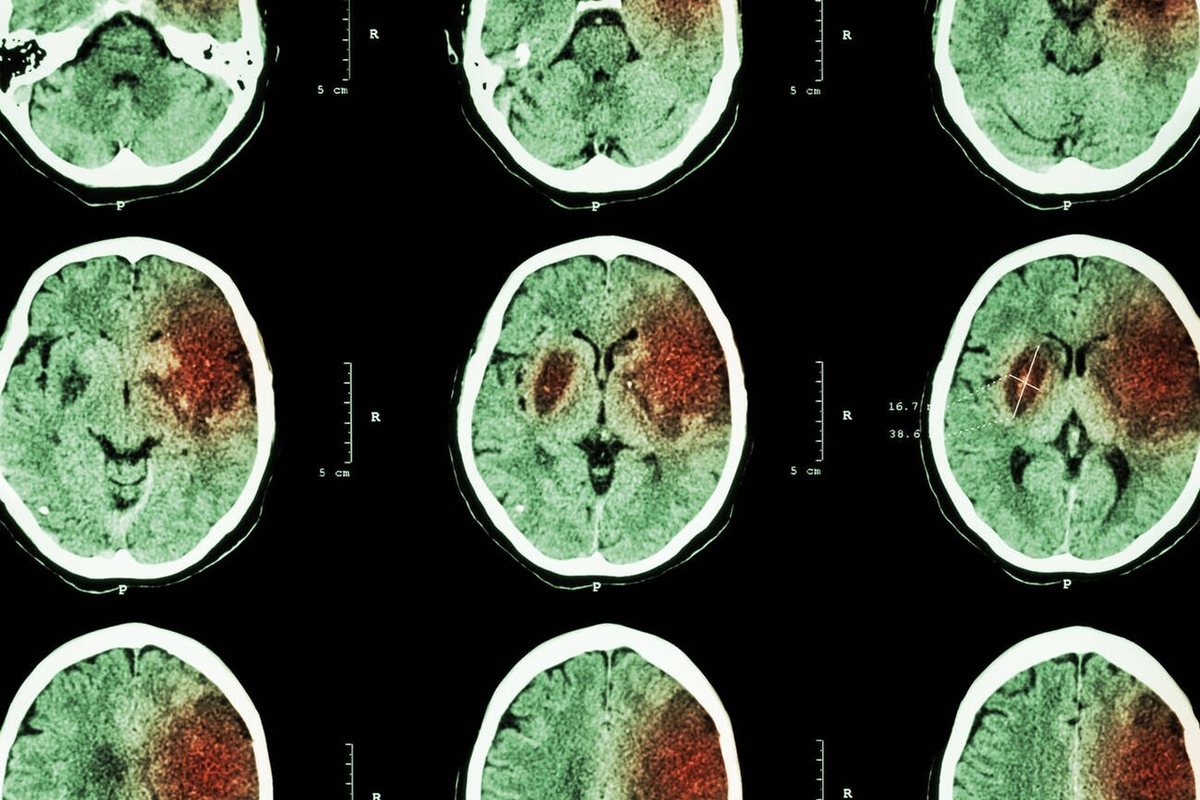
An illustrative multi-slice clinical brain CT scan, not an NHS patient scan. Images like these are what stroke teams read against the clock to decide on urgent treatment.
Image: Goleisureintl · CC BY 4.0 · Wikimedia Commons
Picture a local general hospital in England with a stroke patient who has just come through the door. The hospital has no round-the-clock brain-scan specialist and no surgical suite for clot removal. A doctor orders a CT scan (a fast, detailed X-ray picture of the brain), sends the images to a distant specialist, waits for them to be read, then waits for approval to move the patient by ambulance to a major stroke centre. Each step eats minutes. Together they can push patients past the safe treatment window. For England’s National Health Service (NHS), the bottleneck was time and geography.
| Step | Before AI | With AI |
|---|---|---|
| Reading the scan | Images sent to a distant specialist, then a wait for them to be read. | Software analyzes the images within minutes, at any hour. |
| Who sees it | The surgical team sees the scan only after it is sent and requested. | Local and specialist teams see the same highlighted images at the same time. |
| Transfer decision | Starts late, after reading and approval. | Can begin while the patient is still being settled. |
Spotting the faint shadows and subtle tissue changes that signal a blocked vessel is pattern recognition, and software does it in minutes, at any hour, in any hospital, with no wait for a specialist to be free. The opening for stroke teams was to put the same scan in front of everyone who could help a patient reach treatment. A 2025 systematic review in Radiology synthesized 380 peer-reviewed studies on deep learning (AI that learns visual patterns from large sets of scans) in clot-caused, or ischemic, stroke imaging; 45.0% of them focused on outlining damaged tissue and 33.9% on classifying scans and triaging patients.[2]
How the AI Reads the Scan While Doctors Decide
With backing from the national NHS AI in Health and Care Award, NHS England put AI brain-scan software from specialist medical-imaging companies into its network of acute stroke units, the hospital departments that handle sudden strokes.[3][4] News coverage in 2025 described the tool reaching stroke centres across all 107 units in England.
-
The scan finishes Standard CT
The patient comes out of a standard brain CT. The software starts on the images automatically and finishes within minutes.
-
AI marks what matters Within minutes
It outlines areas of early tissue damage and flags major blocked blood vessels.
-
Both teams see it at once Phones & workstations
Marked-up images go securely and simultaneously to smartphones and workstations at the local hospital and the regional surgical centre.
-
Doctors confirm and act Human decision
Emergency physicians and specialist radiologists (doctors trained to read medical images) review the highlighted scans together in real time and confirm the diagnosis. Then they send a transfer ambulance or start clot-busting drugs.
Before, the surgical team saw the scan only after it had been sent and requested, so talk of a transfer started late. Now the local doctor and the distant specialist look at the same highlighted images together, and the ambulance decision can begin while the patient is still being settled. A 2023 cluster randomized clinical trial across four Houston comprehensive stroke centers (243 patients in the primary cohort) found that automated AI CT alerts pushed to clinicians’ phones cut door-to-groin treatment time by 11.2 minutes and scan-to-treatment start by 9.8 minutes.[5]
Doctors still make the call. The AI shortens the road to it.
The AI-Driven Results: A Five-Year National Study
A national study published in December 2025 in The Lancet Digital Health, a peer-reviewed medical journal, tracked what happened. Researchers from the University of Oxford, Health Innovation Oxford and Thames Valley, NHS England, and the software’s developers followed 452,952 stroke patients across 107 NHS hospitals from 2019 to 2023, the largest real-world evaluation of stroke brain-scan AI to date.[6][7] It drew on England’s national stroke registry, the audit database where hospitals record the care each stroke patient receives, so procedures were counted independently of the software.
Across the 26 evaluation sites using the AI, the share of patients receiving emergency clot-removal surgery doubled, from 2.3% to 4.6%, outpacing gains at hospitals without the software.[8] The denominator is all stroke admissions, and clot removal suits only a subset of those patients, so specialists look for a particular kind of blockage when the scan arrives. The biggest gains came at smaller local stroke centres without on-site specialists. There the AI helped cut “door-in-door-out” time, the wait at the first hospital before a patient leaves for a surgical centre.
At hospitals using the AI, the share of stroke patients receiving clot-removal surgery doubled, from 2.3% to 4.6%.
The Lancet Digital Health · 2019–2023 national studyEarlier NHS pilot programmes at a handful of sites, separate from the five-year study, showed what speed is worth. Sharing AI-marked scans trimmed the average time to leave the first hospital by more than 60 minutes, from roughly 140 minutes to 79, and the share of treated patients recovering with little or no long-term disability rose from roughly 16% to 48%.[9]
The national study followed the handoff all the way to treatment. England’s stroke registry records whether a patient actually received clot-removal surgery, even when the first hospital and the surgical centre are different places. The evaluation brought together clinicians from the NHS and Oxford, including Dr. David Hargroves, the national clinical director for stroke, and Professor Gary Ford.[10][11]
The Larger AI Strategy: Fix One Handoff, Then Go National
The UK government’s official AI Knowledge Hub now holds up stroke imaging AI as a blueprint for public-sector health AI. The NHS fixed one handoff: getting a local hospital’s scan to a specialist hub the moment it exists. It sits in the most clinically mature corner of healthcare AI. Radiology accounts for roughly 76% of all U.S. FDA-authorized AI medical devices,[12] and the UK’s National Institute for Health and Care Excellence (NICE) formally evaluated AI brain-scan software for NHS stroke pathways under Diagnostics Guidance DG57.[13]
Through mid-2024 and 2025, NHS England expanded AI stroke decision-support tools across all 107 acute stroke units in England, with the studied platform alone live in more than 70 hospitals. A regional trial became national clinical infrastructure for tens of thousands of stroke admissions every year.
Local and regional clinicians review the same images while the patient is still at the first hospital. The local team has the patient in front of it. The specialist centre assesses the highlighted vessel and plans for the patient’s arrival. The national registry gives both a common record of what happens after that call.
NHS Wales has rolled out rapid AI CT brain-scan analysis nationally across 15 stroke centers to speed emergency clot-removal decisions.[14]
What Peer Teams Can Copy
Four practical moves for health systems connecting local hospitals with specialist centres in time-critical care.
Phase 1 · Target the Handoff
-
Aim AI at the handoff between generalist and specialist teams
OperationsThe NHS aimed AI at the wait between a local hospital and a specialist centre, where the delay actually lived.
-
Deliver AI results to the devices people already check in an emergency
AI & Workflow DesignMarked-up scans land on the phones and workstations clinicians already carry, so nobody learns a new routine under pressure.
Phase 2 · Track & Govern
-
Follow the patient across the handoff
Governance & RiskRecord the time the scan reaches the surgical team, when the patient leaves the local hospital and which treatment they receive. England’s national registry let researchers examine access to surgery across five years of admissions.
-
Keep humans in final command
Governance & RiskDoctors confirm every diagnosis and decide every transfer. The AI speeds the judgment up.
Footnotes & Sources
- UK Government AI Knowledge Hub — Official NHS Stroke AI Case Overview
- PubMed / Radiology — Deep Learning Applications in Imaging of Acute Ischemic Stroke: Systematic Review of 380 Studies (April 2025)
- The Guardian — Stroke Centres in England Given AI Tool Across 107 Units (Sept 2025)
- UK BioIndustry Association — Technology Partner Disclosure: Brainomix 360 Stroke Thrombectomy Study
- PubMed / JAMA Neurology — Cluster Randomized Clinical Trial of Automated Stroke CT Detection and Treatment Times (2023)
- PubMed / The Lancet Digital Health — 452,952-Patient Prospective Observational Study (Dec 2025)
- Brainomix — Research Summary (Technology Partner: Brainomix 360 Stroke / e-Stroke, 2019–2023 Study)
- Health Innovation Oxford & Thames Valley — Lancet Paper Highlights Role of AI in Stroke Care
- Health Innovation Oxford — Improving Outcomes Through Increased Access to Thrombectomy
- Digital Health — AI Tool Helps Spot Deadly Clots Faster (Dec 2025; Dr. David Hargroves Commentary)
- Diagnostic and Interventional Cardiology — Study Shows How AI Is Transforming Stroke Care (Prof. Gary Ford)
- U.S. FDA — List of Artificial Intelligence-Enabled Medical Devices (Radiology Share)
- UK NICE — Diagnostics Guidance DG57: AI-Derived Software to Analyse CT Brain Scans in Suspected Acute Stroke
- NHS Wales Performance and Improvement — National Rollout of AI Stroke Brain-Scan Technology Across Wales