One product, many ways to ask for it
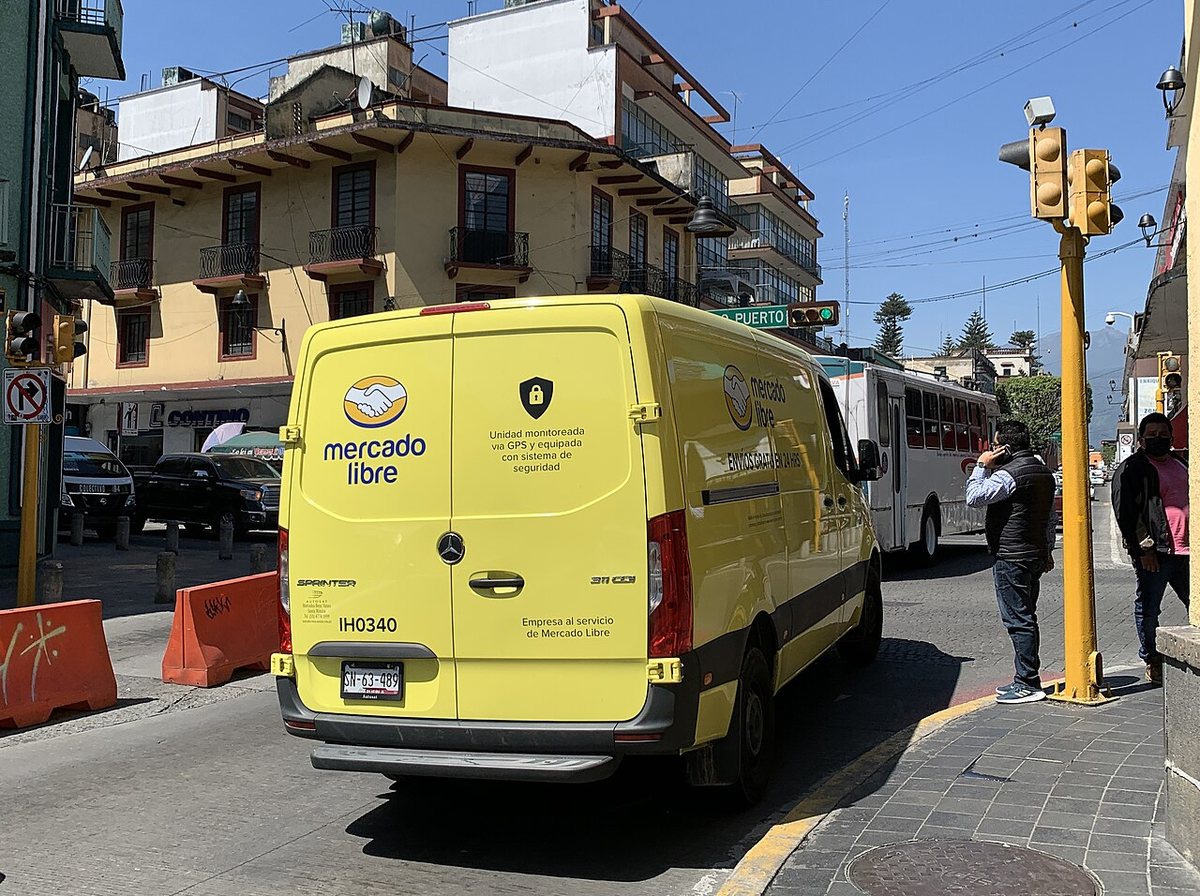
A delivery van working for Mercado Libre in downtown Xalapa, Mexico. The marketplace serves 18 Latin American countries, and in its five largest markets shoppers can search by everyday description or photo.
Photo: Koffermejia (cropped) · CC0 1.0 Public Domain · Wikimedia Commons
Say one buyer in Bogotá and another in Buenos Aires both want a blender part, and each types a different name for it. Mercado Libre, Latin America’s largest online marketplace, lists everything from phone chargers to washing machines for millions of independent sellers. It runs in 18 countries and serves tens of millions of buyers who write in many regional varieties of Spanish and Portuguese.[1] The search box is the front door, and it has to match the buyer’s words to whatever the seller wrote.
| Search input | What the shopper has | How AI finds a listing |
|---|---|---|
| Local name | A São Paulo shopper knows a slang word for sneakers. | Connects a regional term to the product category a seller used. |
| Description | A buyer wants “the thing that keeps avocados fresh.” | Finds products by what they do, even when the buyer cannot name them. |
| Photograph | Someone repairing a blender has a picture of the broken part. | Matches details in the photo to similar items in the catalog. |
The old search hunted for the shopper’s exact words inside a listing. A seller could have the right blender part in stock and never be found, because the shopper guessed the wrong name. A photo gives both of them a second route to the same listing.
How Mercado Libre reads a shopping request
Mercado Libre rolled out the new search in its five largest markets, where most of its shoppers and sales are concentrated. Shoppers can search in the Spanish or Portuguese they use at home, or show the marketplace a picture.
-
Interpret the words Text search
The AI ties slang to product categories and a described job to the items that do it. One product can carry different names in Buenos Aires and Bogotá.
-
Compare the picture Photo search
A shopper uploads a photo. The AI checks its shape, color and other visible details against millions of listings and pulls up look-alikes.[2]
-
Rank the listings Results
The most relevant and trustworthy listings go to the top. Rented banks of specialized graphics chips weigh words and pictures against the catalog and return results in a fraction of a second.[3]
Merchants also use AI to write clearer listings and answer buyers’ questions, which hands search better descriptions to work with. In advertising, a separate tool helps sellers set their bids to promote a product.
More searches lead to clicks and purchases
Shoppers clicked on a larger share of the search results they saw, and a larger share of searches ended in a purchase. Mercado Libre reported both in its April–June 2026 results.[4] Management said the gains more than covered the ongoing cost of running the external AI models.
Across the whole company, quarterly net revenue passed $10 billion for the first time, up 50% from a year earlier. The final quarter of 2025 had reached $8.8 billion, up 45% on the year.[5]
Mercado Libre · Q4 2025 and Q2 2026 resultsAdvertising revenue grew roughly 67% to 73% a year through 2025 and 2026, helped by AI bidding, more sellers, more traffic and new ad formats.
Where else Mercado Libre puts AI to work
The search rebuild landed in the middle of a leadership handover. On January 1, 2026, Ariel Szarfsztejn, who previously ran the commerce business, became global chief executive, while co-founder Marcos Galperin moved to executive chairman.[7] Chief Financial Officer Martín de los Santos decides how money is split between the shopping marketplace and the financial services arm. Search touches both jobs. It changes how buyers reach a listing, and it hands the finance team a running cost to set against the value of the extra purchases.
McKinsey’s 2026 survey of about 21,000 consumers across 11 markets found that 53% on average had used AI for a shopping task in the previous three months, including finding or comparing products.[8]
Amazon answers shoppers’ questions as they find and compare items in its marketplace.[9] Walmart uses AI to judge the freshness of produce headed to its stores.[10]
At Mercado Pago, AI helps estimate how likely borrowers are to repay across this portfolio, and it takes a growing share of customer support.[11]
Mercado Pago reports leading scores for customers’ willingness to recommend it in Brazil, Mexico, Argentina and Chile. In the warehouses, AI helps plan how packages move through fulfillment centers. An interactive assistant answers shareholders’ questions. At U.S. retail sites in September 2026, visits that began with a link from an AI tool were 90% more likely to end in a purchase and brought in 83% more revenue per visit than visits from other sources.[12]
What peer teams can copy
Retail search teams can use these steps to choose a market and measure what happens after a shopper types or uploads a photo.
Phase 1 · Set the launch criteria
-
Measure search gains against the running cost
Data & MeasurementMercado Libre judged its AI search by one test: did extra clicks and purchases outweigh the ongoing bill for AI computing? It said so publicly. Set that test before launch.
-
Start where customers already search most
Rollout & AdoptionIn its five largest markets, Mercado Libre could observe how buyers described the same product in Spanish and Portuguese. Choose a market where enough people use the search box to see what happens after a change.
Phase 2 · Test the path to purchase
-
Point AI at messy human input
AI & Workflow DesignRegional slang, “what it does” descriptions and blurry phone photos are where keyword rules break down. That is where the gains are.
-
Follow the shopper past the results page
Data & MeasurementAsk whether people open a relevant listing and complete the purchase. A photo match can land someone on the right blender part; the seller’s description and delivery details then decide whether the order goes through.
Footnotes & Sources
- BNamericas — Mercado Libre Details AI Strategy Across Search, Seller Assistants & Advertising
- Google Cloud — Showcase Video (Technology Partner: Google Cloud Vertex AI Search, Text & Image Search)
- CoreWeave — Case Study (Infrastructure Partner: CoreWeave & NVIDIA Graphics Chips for AI Search)
- Mercado Libre — Q2 2026 Financial Results Press Release (PDF)
- Mercado Libre Newsroom — Q4 2025 Financial Results
- MarketBeat — Q3 2026 Earnings Call Transcript Highlights
- Mercado Libre Newsroom — Executive Leadership Transition
- McKinsey & Company — Global Consumer Survey on AI-Assisted Shopping Across 21,000 Consumers (2026)
- McKinsey & Company — Global Consumer Survey on AI-Assisted Shopping Across 21,000 Consumers (2026)
- Walmart Corporate Newsroom — Eden: Machine-Learning Freshness Platform Preventing Food Waste
- ROIC.ai — Q4 2025 Earnings Call Transcript (Mercado Pago AI & Customer Satisfaction)
- Adobe for Business — AI Traffic Drives Higher Conversion and Revenue Per Visit in Retail (2026)