Why the last baking round is a hard call
Late in the day, a shopper still expects to find warm bread and a full shelf. For the person deciding how many loaves go into the oven, closing time sets a deadline. Bake too few and a customer who came for bread can go home without it. Bake too many and there may be nobody left to buy the last loaves while they are fresh. Bakery staff at Albert Heijn used to work out those quantities by hand.
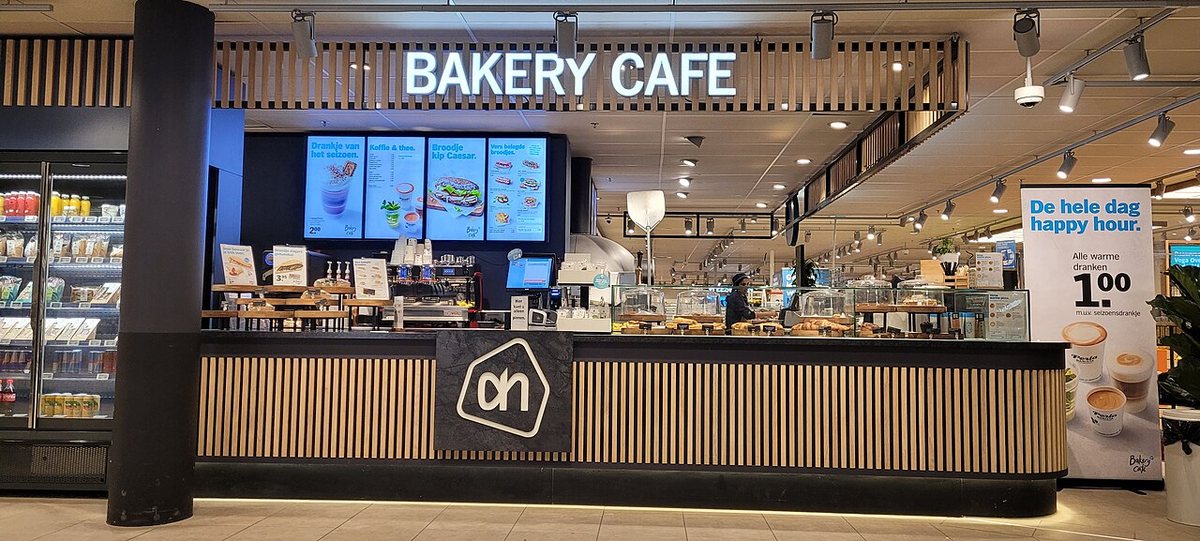
The Bakery Café counter at an Albert Heijn XL store on Argonautenweg in Rotterdam. Across its in-store bakeries, hourly AI bake forecasts and timely discounts help fresh bread find buyers instead of the bin.
Photo: Kniesoor · CC BY-SA 4.0 · Wikimedia Commons
Albert Heijn is the flagship Dutch supermarket chain and the largest grocery brand in Ahold Delhaize. At home, Dutch consumers threw away an average of 33 kilograms of food per person in 2022, and bread ranked among the most-wasted foods, according to the Dutch Nutrition Centre.[1] Worldwide, the UN Environment Programme’s 2024 Food Waste Index counted 1.05 billion tonnes wasted by households, food service and retail in 2022, about 19% of the food available to consumers.[2] A supermarket baker gets a say much earlier, while there is still time to change what goes on the shelf.
A camera and a scale on a kitchen bin can record what went in and how much it weighed. In a 2025 study, researchers interviewed representatives of three technology providers about hospitality deployments. The providers described kitchens using AI to track what they threw out and forecast what they would need, with reported savings in both waste and food costs.[3] But a loaf in the bin can no longer be sold. Albert Heijn steps in sooner: first when staff decide how much to bake, then while customers can still take the bread home.
| Dimension | At the bin | Upstream at Albert Heijn |
|---|---|---|
| Moment | By the time a loaf reaches the bin, the store has lost its chance to sell it. | When staff decide how much to bake, then while customers can still take the bread home. |
| What can still change | The chance to sell that loaf is gone. | The size of the batch, and later the shelf price. |
| Scale | Dutch consumers wasted an average of 33 kilograms of food per person in 2022. | Smart baking and dynamic bread pricing are projected to save more than 2 million kilograms of bread a year. |
Two decisions before a loaf goes to waste
Albert Heijn built an app called Bak, or Smart Baking, and rolled it out to all its Dutch stores in summer 2025.
-
Hourly demand forecast Per store
It forecasts how much bread shoppers will want at each store, hour by hour.
-
Real-time baking rounds During the day
Through the day, it adjusts the baking rounds in real time. A whole-day forecast could get the total right and still leave racks of bread unsold in the evening. The hourly number tells staff exactly what to load for the next round.
-
Dynamic bread pricing From May 2026
Once the bread is baked, the store can still change its price. Albert Heijn began rolling out dynamic bread pricing nationwide on May 4, 2026. The system, called Dynamisch Afprijzen in Dutch, weighs how much bread is on hand, how long it will keep, the time of day, the weather and buying patterns in the neighborhood. A cross-industry group of Dutch data scientists helped develop the software using a sales simulator. It tries different times to offer a discount and learns from the simulated sales which timing works best under those conditions.[4]
-
Staged discounts, shown live Shelf & app
The system lowers the price automatically in stages, up to 70% off. The new price appears immediately on electronic shelf labels, the digital price tags customers see beside the bread, and in the Albert Heijn customer app. A shopper can check the offers at a particular store before deciding where to go. Since September 2025, the chain has grouped offers nationwide under Last Chance Deals (Laatste Kans Koopjes). The same place in the app shows dynamic discounts, Yesterday’s Bread, Surplus Packages, and Fruit & Veggie Bags.[5]
What the 815,000 kilograms measure
Albert Heijn reports that in the second half of 2025, hourly bake forecasts prevented 815,000 kilograms of bread waste, about 1.8 million pounds, in its company-owned stores.[6] During those six months, staff could use the forecast to adjust how many loaves went into the oven. The nationwide rollout of bread discounts followed in May 2026.
Albert Heijn projects that smart baking and dynamic bread pricing together will save more than 2 million kilograms of bread a year. Each loaf now gets two chances. The forecast guides the baker’s batch. Once the bread is out of the oven and on the shelf, the price can still pull a shopper to the loaves that remain.
815,000 kilograms of bread waste prevented in six months, against a projection of more than 2 million kilograms a year.
Albert Heijn · Jul–Dec 2025, company-owned storesCount every food category in Last Chance Deals and the targets grow. Across those offers it aims to increase sales of marked-down food by 25% and save over 5 million kilograms of food. Those goals include other foods alongside bread. They contribute to Ahold Delhaize’s goal of cutting food waste by 50% by 2030, measured against 2016.
What the people running the rollout look for
Sjoerd Holleman oversees Product, AI & Specialty Brands on Albert Heijn’s board and leads Ahold Delhaize’s global AI focus areas. He connects the two bakery decisions to what customers pay. I am proud that we are now bringing together smart baking and dynamic pricing in the bakery section. The challenge is particularly significant in this category. By combining technology and AI with attractive prices for customers, we are making an impact by both reducing food waste and improving affordability for customers.
Nienke Tjerkstra, Albert Heijn’s Sustainability & Health lead, describes what a shopper sees. The closer the products are to their expiration date, the higher the discount for customers, which can reach up to 70 per cent.
Carrefour Belgium uses AI to flag groceries approaching their best-before dates, while Walmart uses it in distribution centers to predict how long produce will stay fresh.[7][8]
In September 2026, Holleman described how the company takes a trial beyond its first stores. The most important thing is to start small but with the end goal in mind... We start pilots in one or two stores, and as soon as they prove successful, we start adding to that and seeing how we can scale. We'd rather fail fast but also scale fast.
He calls Albert Heijn’s Product Organization an architect
. The team translates a business need into something engineers can build.
Across its 17 local brands in nine countries, Ahold Delhaize is building a shared system where developers can run their applications and choose which AI model each one uses.[9]
Noortje van Genugten, Albert Heijn’s VP of Product Operations, explains how the team chooses the work. We always want to build things that deliver value to our P&L, help us meet sustainability targets or help improve the customer or associate experience.
P&L means profit and loss, the account of what a business earns and spends.
The team’s rule is have problem, seek solution
. When Albert Heijn tested a question-and-answer service for store staff, people answered the questions behind the scenes first. That showed what employees most wanted to look up on the shop floor. The team zeroed in on product questions, and requests reached 250,000 a month. The bakery project followed the same recipe: start with a decision a colleague makes mid-shift, then build the tool around it. In McKinsey’s 2026 survey, the companies getting the strongest results from AI were nearly three times as likely as other companies to report substantial changes to how their teams worked.[10]
What peer teams can copy
Three practical moves for grocery and bakery teams cutting bread waste with AI.
Phase 1 · Find the Moment to Act
-
Find the last moment when someone can act
OperationsMap the decisions for one perishable item. Before the oven goes on, a baker can change the size of the batch. Once the batch is on the shelf, a price change can still help it find a buyer. Each decision calls for different information.[11]
-
Follow the discount to the shopper
Customer & FrontlineCheck what someone sees when choosing a store at home and when standing beside the bread. A timely offer can influence both decisions if the app and the shelf show the same price.
Phase 2 · Measure It
-
Give each measure a unit and a period
Data & MeasurementWeigh the bread saved over a baking season and track sales of discounted loaves separately. Include the stores and dates with each figure so the next bakery manager can compare it with a season of their own.
Footnotes & Sources
- Retail Systems — Albert Heijn Rolls Out Smart Tech and Last Chance Bargains to Reduce Food Waste (50% by 2030 Goal and Dutch Nutrition Centre Data)
- UN Environment Programme (UNEP) — Food Waste Index Report 2024
- Frontiers in Artificial Intelligence — Exploring AI-Driven Food Waste Management in Hospitality and Its Potential for Households (2025)
- KickstartAI — Dynamic Pricing for the Supermarket With Reinforcement Learning (Albert Heijn Collaboration)
- Retail Optimiser — Albert Heijn Bundles Four Food-Waste Initiatives Into Its Customer App
- Vakblad Voedingsindustrie — Albert Heijn Deploys AI to Reduce Bread Waste (Bak App 815,000 kg Savings and Nationwide Dynamic Bread Pricing)
- Retail Systems — Carrefour Belgium Rolls Out AI Tool to Prevent Food Waste (Technology Partner: Deligate)
- Walmart Corporate Newsroom — Eden: Machine-Learning Freshness Platform Preventing Food Waste
- Ahold Delhaize Newsroom — Transforming Retail: 10 Questions on How AI Is Empowering Associates, Serving Customers and Driving Sustainability
- McKinsey & Company — AI Is Changing Work; Now It Has to Change the Organization (2025/2026)
- Case-Studies.ai — SC-025: Albert Heijn Cuts Bakery Waste With AI Baking and Pricing