When a batch yields a little more, more patients get a dose
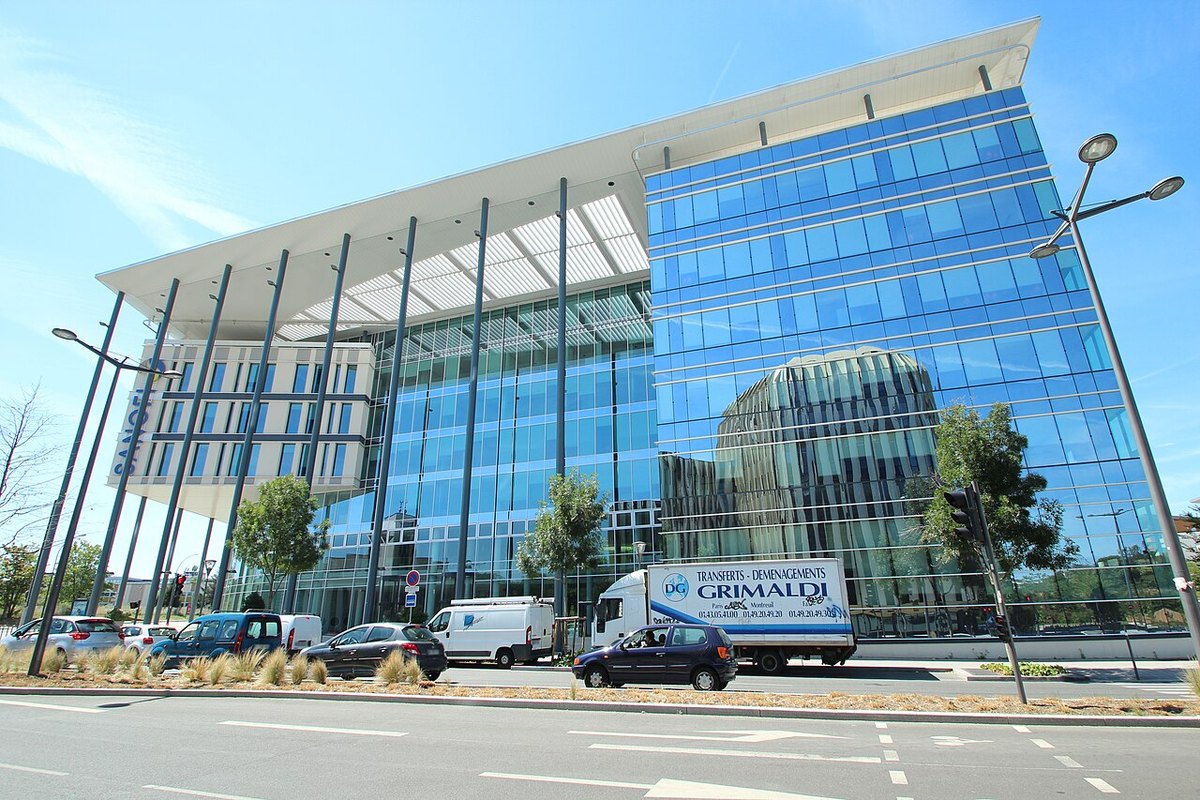
Sanofi’s Massy campus in France, part of the global biopharma company scaling manufacturing AI across 37 production sites.
Photo: Lionel Allorge (CC BY-SA 3.0), via Wikimedia Commons.
In a bioreactor, living cells grow toward a medicine or a vaccine, and each batch moves through tightly controlled steps. Sanofi’s manufacturing network covers 37 sites with more than 28,000 employees and makes about 2 billion doses a year. A small gain in yield per batch adds up fast.[1]
| Difference | SimplY approach (Sanofi) | Periodic data review |
|---|---|---|
| What is analyzed | Live sensor readings plus the settings of the best past batches | Reports pulled together after a batch |
| Time spent on data | People spend far less time crunching numbers | Teams assemble and compare data by hand |
| Who makes the call | People keep the final call | People |
“Yield and cycle time are two that I watch closely,” says Brendan O’Callaghan, Sanofi’s executive vice president for manufacturing and supply.[2]
Live sensor data in, better batch settings out
SimplY is Sanofi’s proprietary AI-powered system. It reads sensors across bioreactors and production lines, follows thousands of data points in real time, and helps teams tune yield and performance batch by batch.[3]
-
Read the sensors Live data
Sensors on the bioreactors and production lines stream thousands of data points in real time.
-
Learn from the best batches Historical
The system studies the control settings from the best-performing batches so their conditions can be repeated.
-
Spot the outliers Analytics
It tracks data trends and flags production outliers. Sanofi reports a gain in yield, the amount of usable product each batch delivers.
-
Keep people and quality systems in charge Human oversight
O’Callaghan says a human-in-the-loop principle is built into every AI deployment, the final call is always human, and no AI goes into production without passing ethical, regulatory and cybersecurity checks.
Sanofi’s newest Digital Manufacturing & Supply Accelerator in Lyon, France, adds digital twins for virtual production simulations, plus AI with connected sensors that watches production in real time and supports predictive decisions. Quality and compliance standards stay central to every rollout.[4][3]
Millions of additional doses without a bigger plant
The approach is “delivering production yield gains of 5% to 10%,” O’Callaghan wrote in a June 2026 article, with millions of additional doses made available to patients without expanding Sanofi’s physical footprint.[5] In a 2025 interview he gave the same range, with extra doses reaching patients faster.[3][2]
A 5% to 10% yield gain is more medicine from the same bioreactors, the same plants and the same teams. In the chart, Index = 100 is an illustrative starting point: Sanofi reports the relative gain, not its starting yield.
Production yield gains of 5% to 10% · Brendan O’Callaghan, Sanofi (June 2026)A separate AI tool automates the review of minor quality deviations, the records made when a step departs from plan. A 2023 Sanofi article credits it with cutting their closure time by 60%.[6]
From one yield tool to an AI-guided network
At VivaTech 2026 Sanofi highlighted two internal programs. BEAM which streamlines moving new drugs from research to industrial scale, and Plasma, which strengthens equipment reliability, continuity and quality across production systems, all guided by its responsible AI framework.[7] An independent May 2026 analysis from IMD business school reported an estimate that pharmaceutical AI investment topped $4 billion in 2025 alone, with manufacturing among the areas where machine learning is well established.[8]
Pfizer’s scientists catch anomalies as they happen in continuous manufacturing of tablets and capsules, and the company has said it aims to raise product yield by 10%.[8][9] Roche told investors that digital twins increased its production yields by 10% and quality by 40%.[10]
What peer teams can copy
Four practical moves for manufacturing and quality teams in regulated plants who want more output from the lines they have.
Phase 1 · Start From Data You Already Hold
-
Mine your best batches
Data & MeasurementFind the control settings behind your best-performing batches and test whether they can be replicated.
-
Pick yield and cycle time as the scoreboard
OperationsSanofi’s manufacturing chief watches yield and cycle time. Pick two numbers and track them before and after.
Phase 2 · Keep People and Quality in Charge
-
Build a human in the loop into every deployment
Human OversightSanofi says the final call is always human and there is no black box.
-
Gate every model before it reaches production
Governance & RiskSanofi puts no AI into production until it passes ethical, regulatory and cybersecurity checks.
Footnotes & Sources
- Sanofi — Manufacturing & Supply (accessed 29 Nov 2026)
- Insigniam Quarterly — Agility Engineered: Sanofi EVP Brendan O’Callaghan (24 Jun 2025)
- Pharmaceutical Online — Sanofi’s Digitalization Road Trip Shifts Into High Gear (16 Sep 2025)
- Sanofi — A new era of biopharma production with AI (28 May 2025)
- Pharmaceutical Executive — The Next Frontier for AI in Health Care Is the Factory Floor (10 Jun 2026)
- Sanofi — AI goes industrial (19 Jun 2023)
- Sanofi — VivaTech 2026: Scaling Artificial Intelligence in Healthcare to Deliver Faster for Patients (16 Jun 2026)
- I by IMD — AI trends in pharma: From R&D to operational efficiency and accuracy for competitive advantage (6 May 2026)
- HealthTech Magazine — How AI Drug Manufacturing Is Changing the Game (26 Feb 2025)
- BioSpace — Drugmakers Hail Early Wins in AI-Driven Transformation of Manufacturing (26 Aug 2025)