When one slow step sets the pace for the whole line
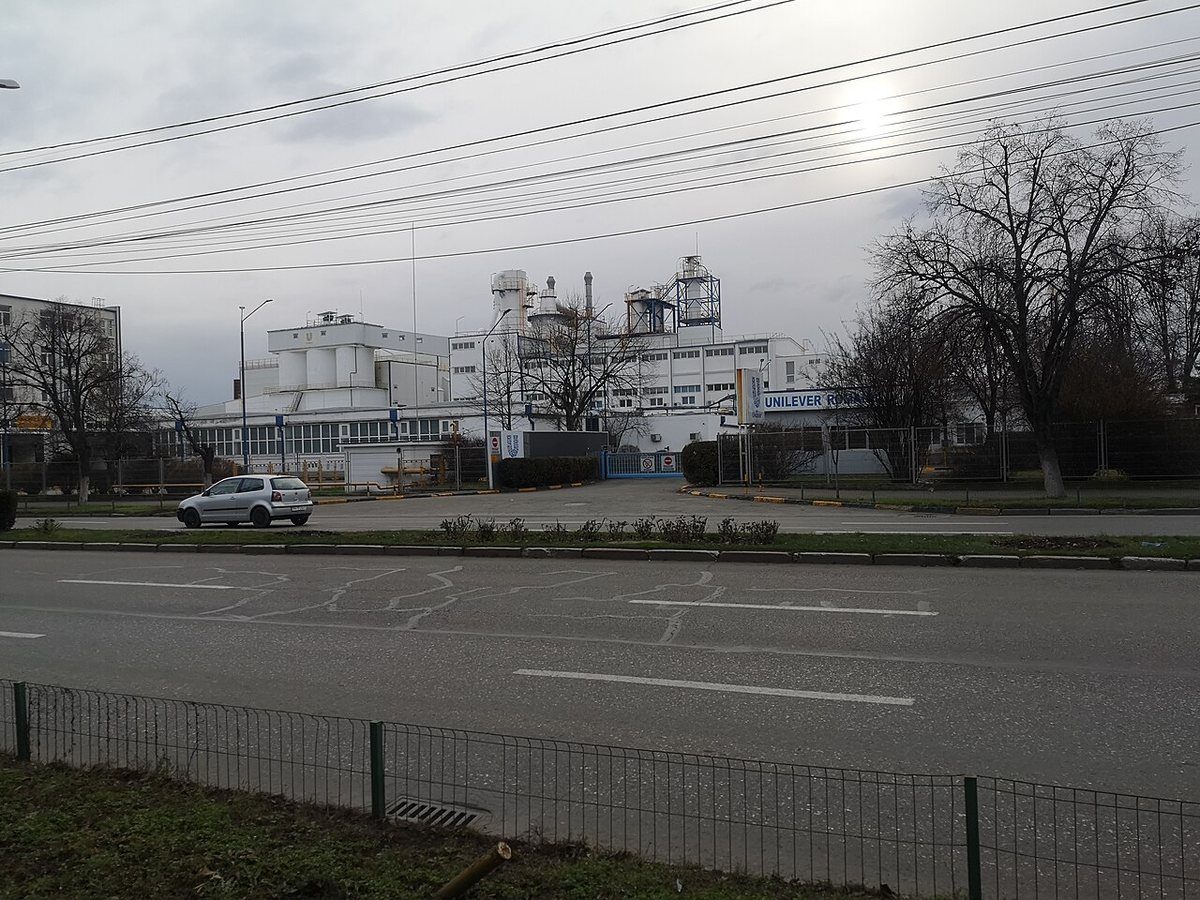
A Unilever manufacturing facility, part of the global production network rolling out virtual factory models.
Photo: Diana wiki2 (CC BY-SA 4.0), via Wikimedia Commons.
When product backs up at one station, the stations before it wait and the stations after it sit idle. A factory line runs only as fast as its slowest step. Spotting those process flow restrictions early is the difference between a smooth shift and a day of small stoppages and scrap.
| Difference | Digital twin (AI target) | Trial on the real line |
|---|---|---|
| Cost of testing a change | A virtual change can be tried again and again. | Each trial uses real product, machine time and operator attention. |
| Data used | Live data from machines and processes on the shop floor. | Snapshots and experience from past shifts. |
| Who decides | People review what the model suggests and approve the action. | People decide from what they can see at the line. |
Unilever describes digital twins as virtual models of factory equipment and production lines that use live data from physical systems on the shop floor to monitor and predict how machines and processes perform.[1]
A live virtual copy of the line
At Raeford, North Carolina, the twin supports production of Dove, Degree and Axe deodorant sticks. Unilever reports it predicts 95% of process flow restrictions in deodorant-stick manufacturing, so teams can see where the line will slow before it does.[2]
-
Mirror the line with live data Shop floor
The twin takes in live readings from machines and processes, so the virtual copy tracks what the real line is doing right now.
-
Predict where flow will slow 95% of restrictions
The model flags the steps most likely to choke the rest of the line, before the stoppage happens.
-
Test fixes virtually Scenarios
Teams can try a change, such as a different sequence or setting, on screen first and see the effect before anyone touches the real line.
-
Approve, then automate the safe parts Human oversight
Today the twin suggests fixes and people sign off on them. Over time it can make low-risk adjustments on its own, under oversight.
Raeford is one of five plants running a twin today, alongside Poznań in Poland, Cu Chi in Vietnam and two sites in India. Unilever selects from several hundred factories worldwide, and trade coverage of the rollout stresses that the cultural side of adopting a twin matters as much as the technology.[3]
Less waste, more output from the same line
At Raeford, the twin delivered a 20% reduction in waste and a 10% uplift in capacity, as reported in Unilever’s June 2026 announcement.[4]
For every 100 units of waste before the digital twin, 80 remain at Raeford.
20% less waste · Unilever (June 2026)At its Hefei, China personal care plant, Unilever has also tied AI and digital twins to an 8% gain in overall equipment effectiveness (OEE, the share of scheduled time a line makes good product at full speed), a 15% shorter batch cycle time and up to 20% less waste.[5] Other sites report their own gains: Poznań cut minor stoppages by up to 20%, Gandhidham reduced product defects by 30% over four years and Cu Chi saved 1% to 2% on premium ingredients.[3]
From one plant to a global network
Starting from its June 2026 announcement, Unilever plans over 18 months to build more than 40 new AI-enabled digital twins, a multi-year program designed as a repeatable blueprint for global rollout.[2]
Five twins run today in the United States, Poland, Vietnam and India, drawn from a network of several hundred factories, so each new twin starts from a proven pattern.[3]
Deloitte’s 2025 survey of 600 executives at large manufacturers found 29% already using AI and machine learning (software that learns patterns from factory data) at the facility or network level and another 23% piloting it, the phased path Unilever is following.[6]
PepsiCo, Nestlé and Danone also use digital twins in their factories and design work.[7] Heineken runs an energy digital twin of a typical brewery alongside AI tools for its factory teams.[8]
What peer teams can copy
Four practical moves for plant operations, supply chain and continuous-improvement teams building a first digital twin.
Phase 1 · Pick the Line
-
Start where a slow step limits output
OperationsChoose one line where a single restriction costs real capacity, and name waste and capacity as the two numbers you will report.
-
Connect live machine data first
Data & MeasurementA twin is only as good as its feed. Confirm you can collect the readings it needs before building the model.
Phase 2 · Earn Trust, Then Scale
-
Keep people approving the changes
Human OversightLet the twin suggest and operators approve. Move to automatic adjustments only for low-risk steps once teams trust the predictions.
-
Package the first win as a blueprint
OperationsDocument the data, the model and the steps from Raeford so the next plant starts from a pattern, not a blank page.
Footnotes & Sources
- Unilever — Digital twins scaled across global manufacturing network (June 2026)
- Accenture Newsroom — Unilever Scales Digital Twins Across Global Manufacturing Network (June 16, 2026)
- Supply Chain Dive — Unilever puts business results first in factory digital twin rollout (October 2026)
- TechInformed — Unilever moves AI digital twins from factory deployments toward process control (June 2026)
- Unilever — How AI is transforming Unilever’s Personal Care business (2025)
- Deloitte — 2025 Smart Manufacturing and Operations Survey (May 2025)
- FoodNavigator — PepsiCo, Danone & Nestlé: how AI is powering F&B growth (June 2026)
- Consumer Goods Technology — Heineken adds gen AI diagnostics and query tool to its connected ecosystem (February 2026)