Sepsis hides in a busy emergency room
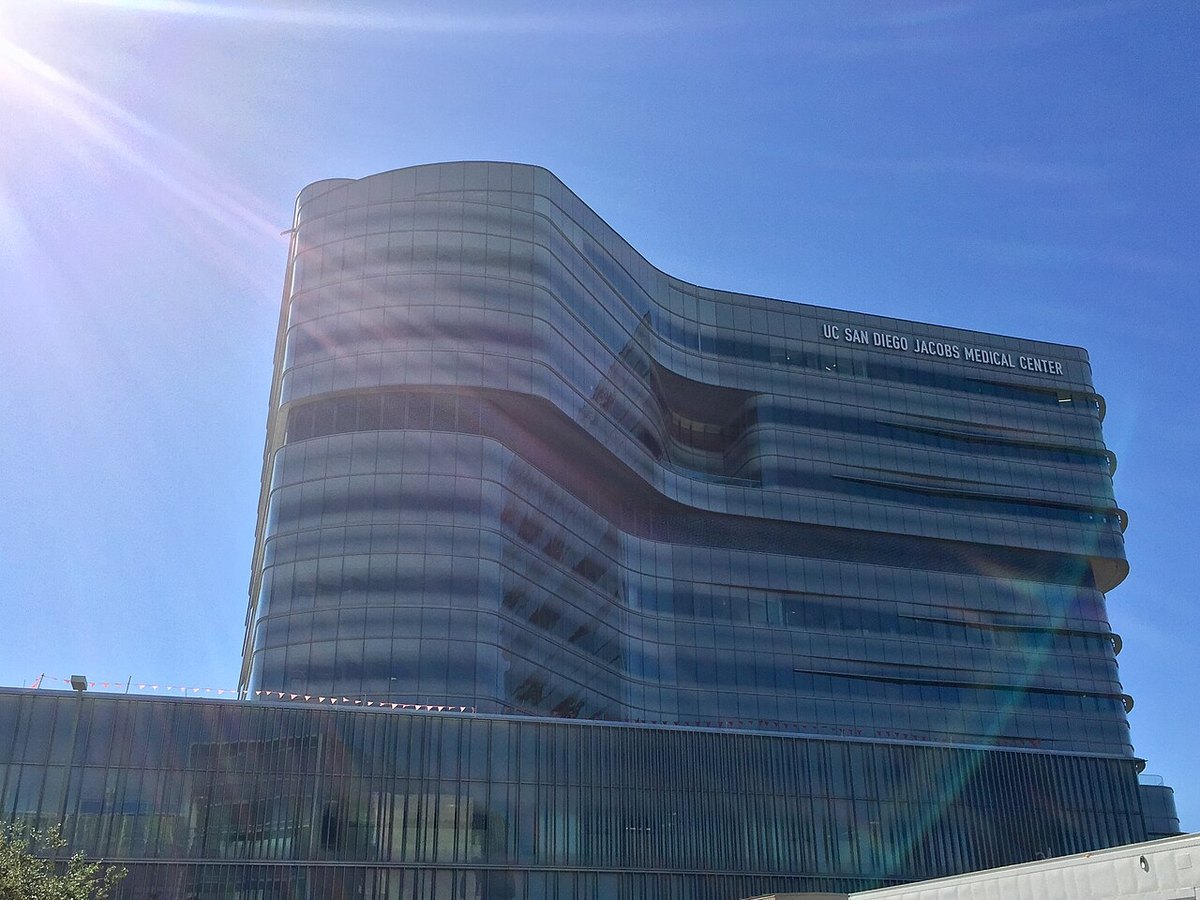
UC San Diego Health’s Jacobs Medical Center in La Jolla, one of two emergency departments where the COMPOSER sepsis warning system was evaluated.
Photo: TritonsRising (CC BY-SA 4.0), via Wikimedia Commons.
The patient who is quietly getting worse can sit in a crowded waiting area and look like everyone else. Sepsis is the body’s extreme response to an infection, and it moves fast. Each year about 1.7 million U.S. adults develop it, and at least 350,000 adults who develop it die in hospital or are discharged to hospice, according to the Centers for Disease Control and Prevention.[1] Early signs, such as a racing heart or a slight fever, look like many other problems.
| The problem | What the AI warning adds | Why it matters |
|---|---|---|
| Early signs look ordinary | Reads vital signs, lab results and other chart data together, every hour | Patterns no single number shows become visible. |
| Treatment is time-critical | Scores the risk of sepsis within the next four hours | Care teams can start the first steps sooner. |
| Too many alarms tire staff | Stays silent when it is unsure or another cause explains the signs | Nurses trust the alerts that do arrive. |
The CDC calls a multidisciplinary hospital sepsis program critical and sets out seven core elements for building one.[2] In its 2025 national survey, 5,430 hospitals responded, uptake improved in 24 of 28 program priorities, and 93% reported a standard sepsis screening process.[3] UC San Diego Health set out to make that screening smarter, earlier and quieter.
An hourly check that knows when to stay quiet
UC San Diego Health built its own deep-learning model, called COMPOSER, and connected it to the electronic health record in the emergency departments at UC San Diego Medical Center in Hillcrest and Jacobs Medical Center in La Jolla. Every hour it pulls each patient’s latest data and estimates the chance that sepsis will set in within the next four hours.[4] The university says the model weighs more than 150 different patient variables.[5]
-
Read the latest chart data Every hour
The platform pulls each eligible adult emergency patient’s record data at hourly resolution, so the model’s view of the patient keeps pace with the shift.[4]
-
Say “unsure” when it should Built-in guardrail
A statistical check compares each patient with the cases the model learned from. If a patient looks too unusual, the model flags the case as “indeterminate” and sends no alert. “If the risk patterns can be explained by other conditions with higher confidence, then no alerts will be sent,” said Shamim Nemati, PhD, a co-author of the study.[5]
-
Alert the nurse, not a dashboard Nurse-facing
The warning covers eligible adults; patients already receiving sepsis treatment or comfort care are excluded. When the risk score is high, an advisory appears as the nurse opens the patient’s chart. The nurse decides whether to escalate and can message the physician directly from the alert.[4]
-
Clinicians choose the treatment Human decision
The nursing team reviews the case with the physician, and together they decide the treatment plan. The model flags the risk. People decide what to do about it.[5]
“It works silently and safely behind the scenes, continuously surveilling every patient for signs of possible sepsis,” said Gabriel Wardi, MD, of UC San Diego Health, another co-author of the study.[5]
Five months, an estimated 22 more survivors
The team published its results in npj Digital Medicine in January 2024. The study compared 5,065 septic adults seen before go-live with 1,152 seen in the five months after it, from January 2021 to April 2023, and adjusted for differences in how sick the two groups were. Among adults with sepsis seen in the two emergency departments, in-hospital mortality was 9.5% observed against 11.4% expected, 1.9 percentage points lower and an estimated 17% relative decrease—the equivalent of about 22 additional patients who survived.[4]
More patients received the full set of time-critical first-hours sepsis care, up from 48.4% expected to 53.4% observed.
Five months after go-live · npj Digital Medicine (2024)Patients also showed less worsening of organ function: the change in organ-failure score over 72 hours was an observed increase of 3.56 points against 3.71 expected. The alerts stayed manageable: the system averaged 235 alerts a month across both departments, about 1.65 per nurse.[4]
From two emergency rooms to the wider hospital
After the emergency department results, UC San Diego Health extended COMPOSER to many inpatient units and planned to switch it on at its East Campus.[5] The same team is now pairing the model with a language model that reads clinicians’ free-text notes. In a prospective evaluation in both emergency departments from May 2024, the combined version reached 70.8% sensitivity, catching 70.8% of sepsis cases, with a 58.2% positive predictive value, meaning 58.2% of its alerts proved correct.[6]
A September 2025 federal data brief found 71% of responding non-federal acute-care hospitals used predictive AI integrated with the electronic health record, for tasks ranging from patient risk to billing and scheduling, in 2024, up from 66% a year earlier.[7] Doctors are adopting AI fast too: 81% of U.S. physicians now use AI in their practices, up from 38% in 2023, according to the American Medical Association’s 2026 survey.[8]
Johns Hopkins Medicine’s sepsis early-warning system was linked, in a 2022 study across five hospitals, to an 18.7% relative drop in mortality when providers confirmed its alerts within three hours.[9] Cleveland Clinic expanded an AI sepsis-detection platform to 13 hospitals in 2025, after a pilot cut false alerts ten-fold.[10]
What peer hospitals can copy
Four practical moves for hospital quality, nursing and clinical informatics teams building an early-warning tool.
Phase 1 · Design for Trust
-
Give the model a way to say “unsure”
AI & Workflow DesignBuild in a check that holds back alerts on patients unlike the training data. Fewer, better alerts keep busy nurses paying attention.
-
Deliver the alert inside the nurse’s workflow
Customer & FrontlinePut the warning on the chart screen nurses already have open, with a one-click way to reach the physician.
Phase 2 · Keep People in Charge and Measure
-
Leave every treatment call with clinicians
Human OversightLet nurses decide whether to escalate and physicians decide what to do. Write that division of roles into the alert itself.
-
Measure deaths, bundle care and alert load together
Data & MeasurementCompare risk-adjusted outcomes before and after go-live, and track alerts per nurse from day one so the benefit and the workload sit side by side.
Footnotes & Sources
- Centers for Disease Control and Prevention — About Sepsis (reviewed August 2026)
- Centers for Disease Control and Prevention — Hospital Sepsis Program Core Elements
- Centers for Disease Control and Prevention — Hospital Sepsis Management and Practices: Findings from the 2025 NHSN Annual Survey (August 2026)
- Boussina et al. — “Impact of a deep learning sepsis prediction model on quality of care and survival,” npj Digital Medicine 7, 14 (January 2024)
- UC San Diego Today — Study: AI Surveillance Tool Successfully Helps to Predict Sepsis, Saves Lives (January 2024)
- UC San Diego Health researchers — Prospective evaluation of the COMPOSER-LLM sepsis prediction system, npj Digital Medicine (2025)
- Assistant Secretary for Technology Policy / ONC — Data Brief No. 80: Hospital Trends in the Use, Evaluation, and Governance of Predictive AI, 2023–2024 (September 2025)
- American Medical Association — AI usage among doctors doubles as confidence in technology grows (March 2026)
- Adams et al. — “Prospective, multi-site study of patient outcomes after implementation of the TREWS machine learning-based early warning system for sepsis,” Nature Medicine (July 2022)
- Cleveland Clinic — Expanded rollout of an AI platform for sepsis detection (September 2025)