Why a sunny gate can still have a weather delay
A traveler at a sunny gate may be waiting for an airplane on the far side of a thunderstorm. The person deciding whether to call family or rebook a connection has a different view from the operations team. Staff can see where the incoming plane is, whether a runway has closed for construction, or which part a maintenance crew is replacing. United saw an opportunity to put that information directly in travelers’ hands.
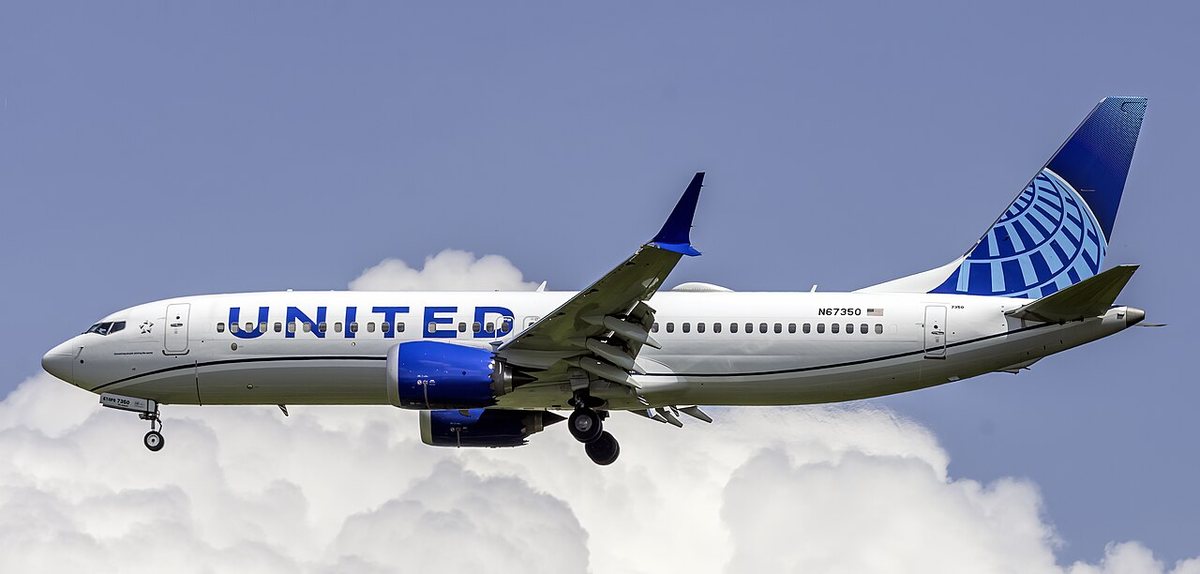
A United Boeing 737 MAX 8 on approach. Behind every one of United’s daily flights is an operational story, and the airline now uses AI to help its writers explain delays to travelers in plain English.
Photo: Acroterion · CC BY-SA 4.0 · Wikimedia Commons
Back in 2018, United Airlines began sharing those details by creating a small human writing team at its Chicago headquarters called Every Flight Has a Story.[1][2] Those human “storytellers” sat alongside flight operations staff, tracked down the true cause of a delay, and sent clear, plain-English updates to affected travelers. When storms or heavy traffic affected dozens of flights at once, the writing team could research about 15% of delayed flights, and 5% of all delay messages went through the full writing process.
| Dimension | Writers alone | Writers with AI |
|---|---|---|
| Finding the cause | Storytellers track down each delay alongside operations staff. | AI gathers the live operational record for the flight automatically. |
| Messages with a full explanation | 5% of delay messages. | 35% of delay messages—a sevenfold rise. |
| Final send | A Chicago writer. | A Chicago writer reviews every AI draft before it goes out. |
How United’s AI Turns Cryptic Flight Codes Into Plain English
United gave its Chicago writers a way to draft more of those messages. Its engineers built an internal platform called Mars, where they can choose among different AI models for tasks such as turning flight records into a first draft.[3][4] The writers already knew which details make a delay understandable. Connecting their desk to the airline’s live records gave them those details in one place.
-
Gather the live record United Data Hub
United connected Mars directly to its United Data Hub, which streams real-time operational data from across the airline. When a flight runs late, the AI automatically gathers the live operational record—runway construction notices, air traffic control ground holds, crew notes, maintenance logs, and localized weather radar maps.[5]
-
Translate the codes Within seconds
Within seconds, the AI translates dense internal airline codes into a plain-English draft explanation tailored to that exact flight.[6]
-
A writer checks the draft Human send button
Before any AI-written delay alert goes out, a Chicago staff writer reviews the draft against the latest live operational status, edits any phrasing that feels off, or holds the message if conditions just changed.[7]
-
Deliver to the traveler App & SMS
Once approved, the alert goes straight to travelers through the United mobile app or by SMS text message—often paired with live weather-radar maps during storm delays.
United kept humans on the final send button. This messaging AI works alongside other operational AI systems at United, such as ConnectionSaver, which uses AI forecasts to help operations teams decide when holding a departing plane for a few extra minutes will let late-arriving connecting passengers make their flight without disrupting the rest of the network. Across the industry, an aviation technology industry survey found that 90% of airlines are actively investing in AI, alongside $36 billion in annual airline IT spending. It also found that 63% already use AI in operations control to manage disruptions and aircraft and crew schedules.[8]
The AI-Driven Results—and What Real Flyers Noticed at the Gate
United’s writing team scaled past 100,000 custom delay alerts during initial expansion and has since pushed hundreds of thousands of AI-assisted customer notifications overall (since a single delayed flight sends alerts to many passengers).
In an April 2025 interview, Chief Information Officer Jason Birnbaum reported that the share of delay messages receiving full custom explanations jumped sevenfold—from 5% to 35%.[9] United had also set a separate long-term goal of covering 50% of all delayed flights. On disruptions covered by the program, Birnbaum cited a 6% lift in Net Promoter Score (NPS)—a widely used business measure of how likely customers are to recommend a brand.
The share of delay messages carrying a full custom explanation rose sevenfold, from 5% to 35%.
CIO Jason Birnbaum · April 2025 interviewTwo travelers’ accounts show what matters at the gate. One passenger appreciated a text explaining that the crew was waiting for a repair to the pilot’s seat.[10] Another described getting an alert after a long wait on the runway. It directed the traveler straight to the departure gate in time to catch the last connecting flight of the day.[11] The first message answered a question someone looking through the terminal window could hardly resolve. The second gave the traveler an immediate decision to make on arrival.
The Larger AI Strategy Behind the Rollout
AI-assisted delay messaging feeds directly into United’s top-level corporate strategy. Under CEO Scott Kirby’s multi-year United Next growth plan, the airline invests more than $1 billion every year in customer-facing upgrades—including seatback entertainment screens, high-speed in-flight Wi-Fi, and cabin renovations—to win repeat, brand-loyal travelers.[12][13] Transparent, AI-powered communication at the gate protects that customer trust during the exact moments when travel goes wrong.
On United’s Q4 2025 earnings call, President Brett Hart noted that November set a monthly Net Promoter Score record and reported that more than 85% of United passengers use the United mobile app on travel day[14]—a figure that climbed to 86% in Q1 2026.[15] Because nearly nine out of ten travelers used the app on travel day, adding AI-assisted alerts to the app gave the writing team a direct way to reach them without asking customers to learn a new tool.
Behind the scenes, CIO Jason Birnbaum explained in an interview and research briefing with the MIT Center for Information Systems Research (CISR) that United is redesigning its operations around real-time decision-making—summarizing the company’s philosophy simply: in aviation, the airline that makes accurate decisions fastest wins.[16] McKinsey’s global workplace AI research finds top-performing organizations are nearly three times more likely to redesign end-to-end operational workflows around AI.[17] At the same time, United has drawn a clear security boundary around AI: while using AI to draft customer updates, the airline restricts unauthorized third-party AI booking bots from accessing customer accounts in order to protect passenger passwords, payment cards, and loyalty miles.[18][19]
Delta Air Lines is expanding its in-app AI travel assistant to all SkyMiles members, for real-time trip and disruption updates.[20] American Airlines runs machine-learning gate assignment and connection tools at major hubs.[21] Alaska Airlines uses AI flight-routing software in its operations center.[22]
What Peer Teams Can Copy
Four practical moves for customer-communication and operations teams turning live operational data into plain-English updates.
Phase 1 · Build the Draft
-
Start with messages that staff already write well
OperationsAsk a writer to walk through one delay, from the operations record to the text a traveler receives. That reveals which facts the first draft needs to include and which details can change while the writer is checking it.
-
Give an editor the final send button
Human OversightLet AI assemble the weather, maintenance and crew details. Have the writer compare the draft with the latest record, then read it from the standpoint of someone at the gate. Can that person tell which part of the journey is affected and what to do next?
Phase 2 · Deliver & Protect
-
Deliver AI outputs inside a channel customers already open
Customer & FrontlineUnited’s AI alerts worked immediately because 86% of travelers already used its mobile app on travel day—zero friction and zero new habits required.
-
Set access according to the job
IT & EngineeringA writer preparing a delay alert needs the flight’s operational record. Access to a passenger’s account, booking or payment details serves a different purpose. Decide who can use each source of information as part of designing the service.
Footnotes & Sources
- Runway Girl Network — United Airlines Explains “Every Flight Has a Story” Initiative
- Forbes — United Airlines CIO Connects People and Tech for Customer Experience at Scale
- CIO — United Airlines Sets Its Flight Plan for GenAI Success
- MIT CISR — Interview Highlights With CIO Jason Birnbaum (Cloud Stack: AWS & Amazon Bedrock)
- United Airlines Newsroom — Live Radar Maps & AI Weather-Delay Updates
- Forbes — United Airlines Turns to Generative AI to Help Explain Flight Delays
- United Airlines — 2024 Corporate Responsibility Report (AI Governance)
- SITA — Air Transport IT Insights: Aviation Technology Investment and AI in Operations Control (2025/2026)
- CIO — United Airlines’ AI Strategy: The Airline That Makes Decisions Fastest Wins
- Reddit (r/unitedairlines) — Passenger Thread on Broken Pilot’s Seat Delay Text
- Reddit (r/unitedairlines) — Passenger Thread on Making the Last Connection
- CX Dive — United Is Focused on Winning Brand-Loyal Customers (United Next)
- United Investor Relations — Cabin & Connectivity Investments (In-Flight Wi-Fi Partner: Starlink)
- United Airlines — Q4 2025 Earnings Call Transcript
- United Investor Relations — Q1 2026 Financial Results (PDF)
- MIT — Public Research Briefing on Real-Time Business Decision-Making
- McKinsey & Company — AI Is Changing Work; Now It Has to Change the Organization (2025/2026)
- Business Travel News — United Restricts Unauthorized Third-Party AI Agent Access
- United Airlines Newsroom — Third-Party Account Access Policy
- Delta News Hub — Delta Concierge Expands to All SkyMiles Members
- American Airlines Newsroom — Machine Learning Smart Gating and Hub Operations
- Alaska Airlines News — AI Flight Route Optimization in Network Operations