Every flight plan starts with a choice about the air ahead
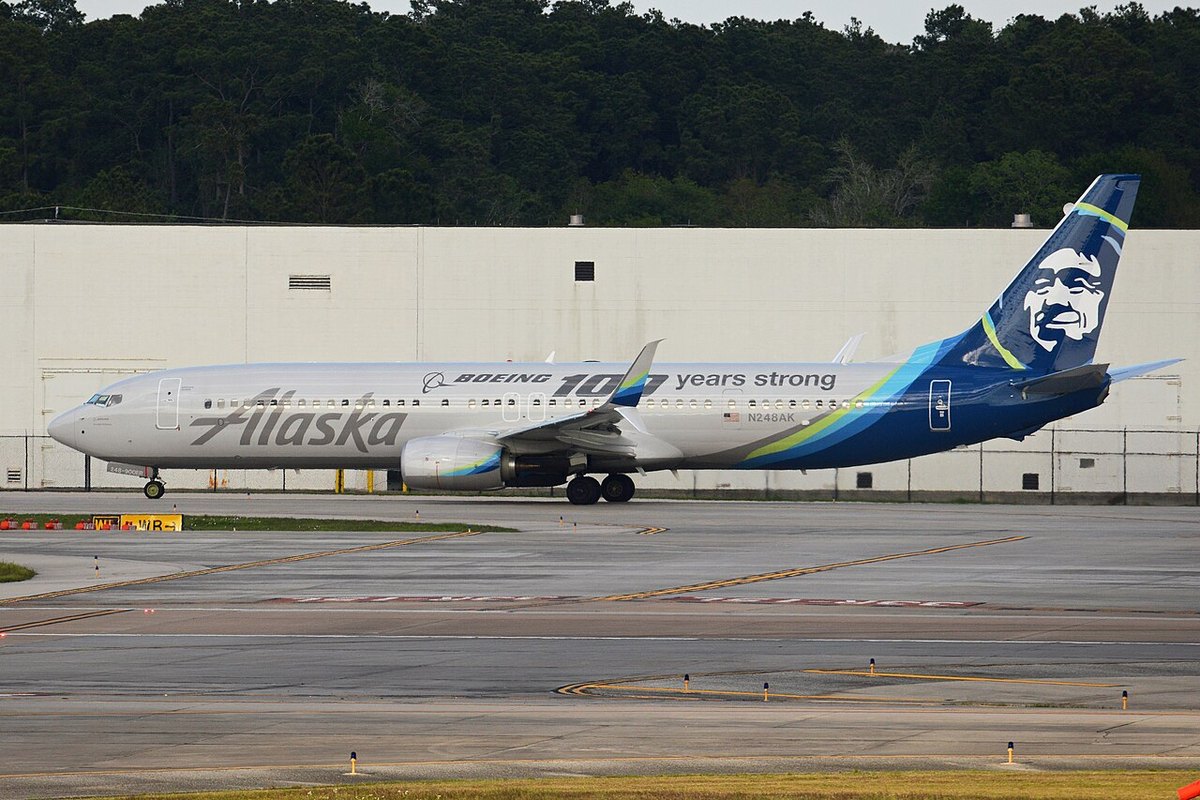
An Alaska Airlines Boeing 737-990ER taxiing ahead of departure. Dispatchers review AI route options before flights leave the gate.
Photo: Alan Wilson (CC BY-SA 2.0), via Wikimedia Commons.
Before an Alaska Airlines jet pushes back, a dispatcher has already chosen the air it will fly through. Which path. How high to climb. Which crowded airspace to skirt. Weather, winds and turbulence keep reshuffling the best answer, and all of it has to be weighed before the aircraft leaves the gate.
Alaska wanted its dispatchers to see more options, sooner, with their judgment still in charge. It brought in an AI route tool built with an outside aviation software firm. By August 2024 the tool had been at work in the airline’s Network Operations Center for about four years.[1][2] The dispatcher still picks when and how to use each route.[3] In a six-month trial that began in 2020 and was announced in 2021, the tool identified a better route or a fuel-saving opportunity on 64% of mainline flights. Dispatchers accepted 32% of the trial’s recommendations.[4]
| Difference | AI route options for dispatch (Alaska approach) | Route chosen from the usual planning tools |
|---|---|---|
| What gets weighed | Weather, winds, turbulence, airspace constraints and air traffic volume | The standard planning inputs for the flight |
| Who decides | The dispatcher, who chooses when and how to use each route | The dispatcher |
| What the aim is | Safe, air-traffic-compliant routes that use less fuel and less time | A safe, compliant route |
Route options land in front of the dispatcher, who decides
The tool reads weather patterns, winds, turbulence, airspace constraints and air traffic volume, then hands route recommendations to dispatchers and pilots. Every recommendation has to be safe and follow air traffic control. The aim is to burn less fuel and spend less time in the air.[1]
-
Gather the flight picture Data
Weather patterns, winds, turbulence, airspace constraints and air traffic volume go into the tool.
-
Propose route options Algorithm
The tool suggests routes that stay within air traffic control rules and aim for less fuel, less flight time and less congested airspace.
-
Decide with judgment Dispatcher
The dispatcher decides when and how to use each route, and the airline says safety comes first in that choice.[3]
-
Fly the agreed plan Flight crew
The chosen route reaches the pilots as part of the flight plan they fly.
Dispatchers share legal responsibility for each flight with the captain. The tool is built to back them up in that job, and the call stays theirs.[5]
More than 1.2 million gallons of fuel saved in 2023
Alaska reports that in 2023 the tool’s routes saved the airline over 1.2 million gallons of fuel. That equals about 11,958 metric tons of carbon dioxide. On average, the tool offered a better route option on about 55% of the airline’s flights.[1]
The six-month pilot saved about 480,000 gallons. The full year of 2023 reached more than 1.2 million, roughly two and a half times the pilot’s savings.
Fuel saved by AI-suggested routes · Alaska Airlines Newsroom (Aug 2024) and 2021 pilot announcementMinutes came off the clock, too. In the trial, the tool’s routes ran about 5.3 minutes faster on average than routes built by hand. From January to September 2022, the tool averaged about 2.7 minutes saved per flight across the fleet.[5][6]
Four years in daily dispatch, aimed at net zero by 2040
Alaska has set two public goals: to become the most fuel-efficient U.S. airline by 2025, a target it stated in 2024, and to reach net-zero carbon emissions by 2040. In August 2024 the airline’s newsroom tied the route tool to both, four years into its use.[1]
Air France has documented its own use of AI to plan flight trajectories.[7] A 2025 World Economic Forum report on intelligent transport holds up Alaska’s route planning as an example of AI helping aviation cut fuel use and emissions.[8]
The savings carried into the next year. Alaska’s 2024 Corporate Impact Report counts over 900,000 gallons of fuel saved in 2024, after over 1.2 million gallons in 2023.[9]
Every route it proposes works toward the 2040 net-zero goal and the nearer push to fly on less fuel.[1]
What peer teams can copy
Four practical moves for operations and dispatch teams that want better route options without handing decisions to software.
Phase 1 · Start With the Flight Picture
-
Feed the tool the data your dispatch team already uses
Data & MeasurementWeather, winds, turbulence and air traffic volume are the inputs that matter. Start with the feeds your team already trusts.
-
Set safety and compliance as fixed limits
OperationsOnly offer routes that already meet air traffic rules, so every option the dispatcher sees is one they could legally file.
Phase 2 · Keep the Decision With People
-
Make the dispatcher the decision-maker
Human OversightFrame route options as decision support. The dispatcher chooses when and how to use each one, as Alaska describes its own process.
-
Track fuel and time results against a baseline
Governance & RiskCompare fuel and flight time with and without the suggestions, so every year’s savings are measured against one yardstick.
Footnotes & Sources
- Alaska Airlines Newsroom — How AI is helping Alaska Airlines plan better flight routes and lower emissions (9 Aug 2024)
- Alaska Airlines Newsroom — Alaska Airlines and Airspace Intelligence announce first-of-its-kind partnership (25 May 2021)
- Alaska Airlines Newsroom — Alaska dispatchers and Silicon Valley are revolutionizing more efficient, sustainable ways to fly (25 May 2021)
- Flying Magazine — Alaska Airlines Optimizes Traffic Flow Using Artificial Intelligence (3 Jun 2021)
- Popular Science — Alaska Airlines is using artificial intelligence to craft flight plans that save fuel, and time (updated 8 Jun 2021)
- Aerospace America — AI: how it’s delivering sharper route planning (1 Feb 2023)
- Air France — Air France and artificial intelligence (AI)
- World Economic Forum — Intelligent Transport, Greener Future (2025)
- Alaska Air Group — 2024 Corporate Impact Report (2025)