Thousands of store deliveries, one plan per night
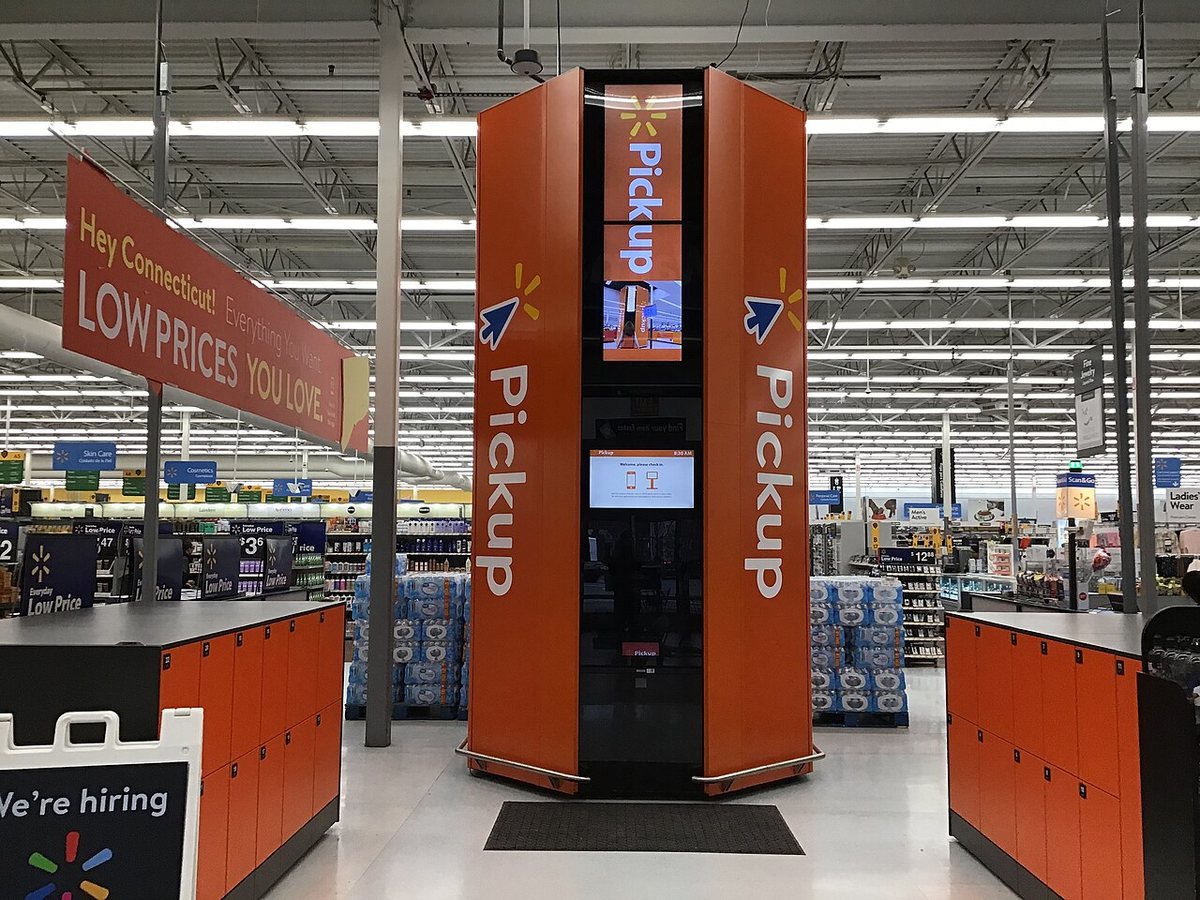
Inside a Walmart Supercenter fulfillment pickup zone fed by daily regional grocery distribution routes.
Photo: Mike Mozart (CC BY 2.0), via Wikimedia Commons.
Every day, trucks leave Walmart’s grocery distribution centers carrying the fresh and frozen food that stocks store shelves the next morning. The network is huge: 47 grocery distribution centers serve more than 4,700 Walmart stores and over 600 Sam’s Clubs, and Walmart stores sit within ten miles of 90% of the U.S. population. Every route has to honor more than 50 separate rules—from store delivery windows to federal limits on how long a driver may work.[1]
| Planning question | What the AI planner weighs | Why it matters |
|---|---|---|
| Which stores share a truck? | Store locations and each store’s delivery window | Fewer, fuller trucks reach every store on time. |
| Will the load fit? | The exact trailer space each order needs | A plan only saves miles if the freight really fits. |
| Who can drive it? | Driver hours under federal safety rules | Routes stay safe and legal from the first stop to the last. |
Fewer miles also means less exhaust. Transportation produced 29% of U.S. greenhouse gas emissions in 2022, and medium- and heavy-duty trucks were 23% of that share, according to the U.S. Environmental Protection Agency.[2] Running a truck cost an industry-average $2.336 per mile in 2025, 3.4% more than a year earlier, according to the American Transportation Research Institute.[3]
A planner that redraws the network every day
Walmart’s in-house Load Planner plans and optimizes truck routes and trailer loads for its grocery network. It tries route after route, keeps the best plan so far, and keeps improving it. It takes at most 15 minutes to plan a distribution center’s routes and one second to plan an efficient truck load.[1]
-
Read the day’s orders Inputs
The planner starts from what each store has ordered, where it is and when it can receive a truck. Walmart describes its route mapping as weighing time, location and store delivery windows together.[4]
-
Search for better routes Within 15 minutes
The planner rebuilds routes and swaps stops between trucks again and again, keeping a change only when it shortens the network’s total miles without breaking a rule.
-
Check every trailer really fits One second per load
Loading checks confirm each order physically fits the trailer before a route is accepted, so the plan the dispatcher sees is one the warehouse team can actually load.
-
Fill the trip home Backhauls
Load Planner lines up pickups along the way back, so a truck does not return to the distribution center empty, and Walmart’s dispatch system plans each driver’s route around their hours, location and availability.[5]
The work earned Walmart the 2023 Franz Edelman Award from INFORMS, the professional society for operations research and analytics, which honors applied work with measured results.[6]
One fiscal year, four measured gains
A peer-reviewed paper written by Walmart’s supply-chain and technology teams, published in the INFORMS Journal on Applied Analytics in 2024, reports that in fiscal year 2023 Walmart eliminated 108,000 truck routes covering 33 million miles, saving $91.5 million and preventing 98.6 million pounds of carbon dioxide emissions.[1]
From 47 grocery distribution centers to more than 5,300 stores, the same planner removed 33 million truck miles in a single year.
Fiscal year 2023 · INFORMS Journal on Applied Analytics (2024)All four numbers come from the same fiscal year and the same method. The authors divided total miles saved by the fleet’s miles per gallon to find the diesel fuel avoided, then applied 10,180 grams of carbon dioxide per gallon to calculate the emissions avoided.[1]
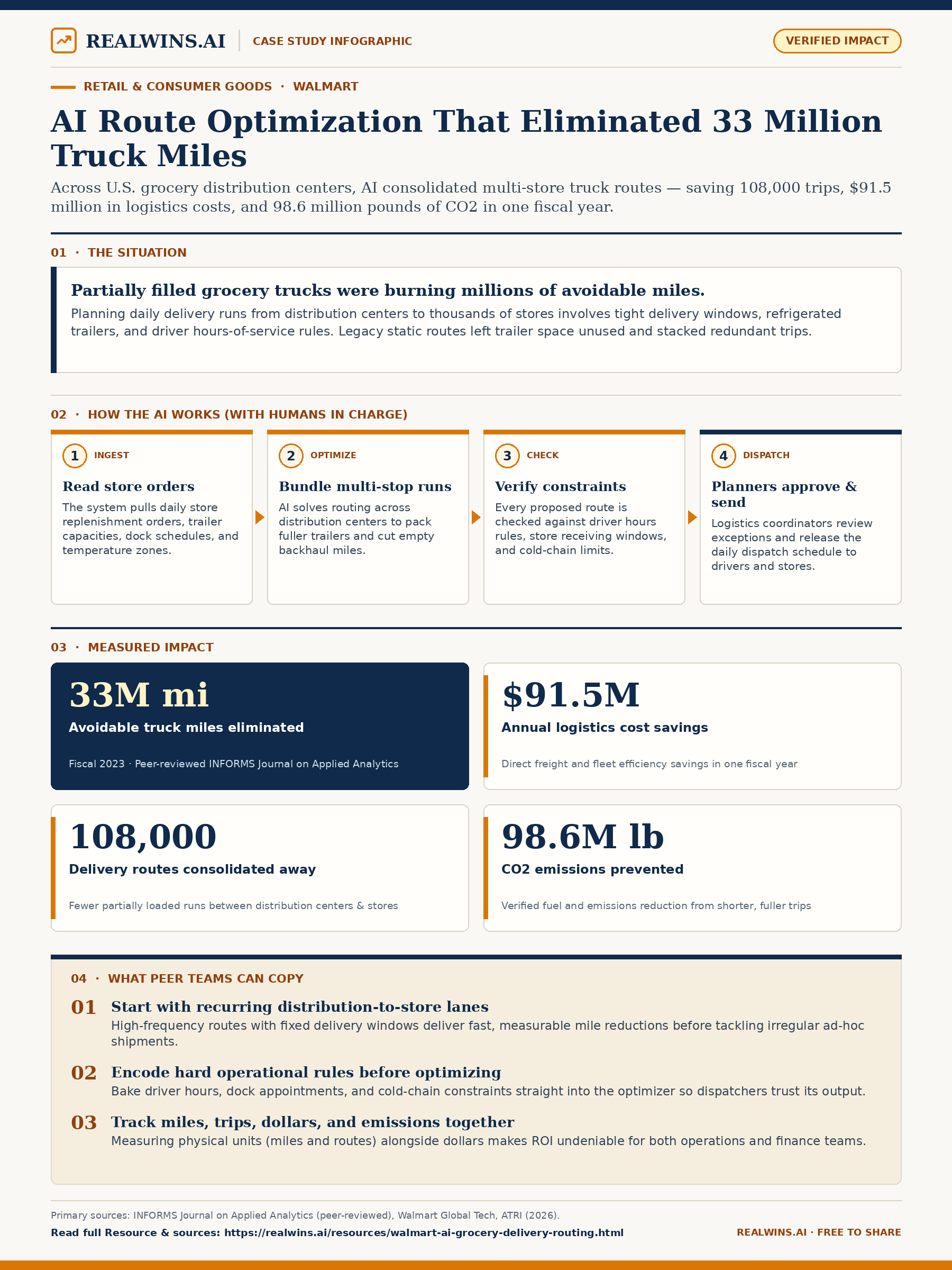
VISUAL INFOGRAPHIC · FREE TO SHARE
Walmart AI Route Optimization — Visual Summary
A high-resolution, single-page visual summary of how Walmart’s AI eliminated 33 million grocery truck miles, 108,000 routes, and $91.5M in annual logistics costs.
From an internal planner to a product other fleets can use
In March 2024, Walmart Commerce Technologies began offering its AI-powered route optimization to other businesses as a software product. “By adopting our at-scale, AI-powered tech, businesses can eliminate the need and expense of developing their own technology,” said Anshu Bhardwaj, chief operating officer of Walmart Global Tech and Walmart Commerce Technologies.[4]
By December 2025, Walmart could deliver to 95% of U.S. households in under three hours.[7] Behind that speed, specialized digital agents each keep making small decisions on tasks such as routing, and some customers already see delivery windows under 30 minutes.[8]
Freight is a large part of supply-chain emissions, and a 2025 survey of 1,203 supply-chain professionals in 97 countries by the MIT Center for Transportation & Logistics and the Council of Supply Chain Management Professionals found that 85% of companies are continuing their supply-chain sustainability practices.[9]
UPS’s in-house route optimization system was estimated by INFORMS to cut fuel use by 10 million gallons a year.[10] FedEx said in February 2025 that its global rollout of a pickup-and-delivery route-optimization tool was underway.[11] Both apply routing optimization to their own fleets.
What peer teams can copy
Four practical moves for distribution, transportation and fleet teams adapting AI route and load planning.
Phase 1 · Model the Network Honestly
-
Write down every rule before you optimize
OperationsList store delivery windows, trailer limits and driver-hour rules in one place. Walmart’s planner honors more than 50; a plan that ignores even one will not survive the loading dock.
-
Set a planning time budget
Data & MeasurementDecide when the plan must be ready for dispatchers and size the search to fit. Walmart allows up to 15 minutes per distribution center and one second per trailer load.
Phase 2 · Run It and Prove It
-
Plan the trip home, too
OperationsLine up supplier pickups on the return leg so trucks come back full. Treat empty miles as a number the planner works to shrink.
-
Report miles, dollars and carbon from one dataset
Data & MeasurementMeasure routes removed, miles saved, cost and emissions for the same year, using one written method: miles saved, divided by fuel economy, times a published emissions factor.
Footnotes & Sources
- Mehrotra et al. — “Optimizing Walmart’s Supply Chain from Strategy to Execution,” INFORMS Journal on Applied Analytics 54(1), 2024
- U.S. Environmental Protection Agency — Carbon Pollution from Transportation (2022 data, updated 2026)
- American Transportation Research Institute — An Analysis of the Operational Costs of Trucking: 2026 Update
- Walmart — Walmart Commerce Technologies Launches AI-Powered Logistics Product (March 2024)
- Walmart — Retail, Rewired: Load Planner and dispatch planning (July 2025)
- INFORMS — Walmart Awarded the 2023 INFORMS Franz Edelman Award (April 2023)
- Walmart — Delivery to 95% of U.S. households in under three hours (December 2025)
- Walmart Global Tech — Inside the AI network orchestrating Walmart’s fastest holiday deliveries yet (December 2025)
- MIT News — MIT Center for Transportation & Logistics and CSCMP State of Supply Chain Sustainability report (October 2025)
- INFORMS — UPS On-Road Integrated Optimization and Navigation (ORION) Project
- FedEx — FedEx Acquires RouteSmart Technologies, Strengthening Global Pickup and Delivery Optimization (February 2025)