Gate conflicts that waste taxi time and fuel
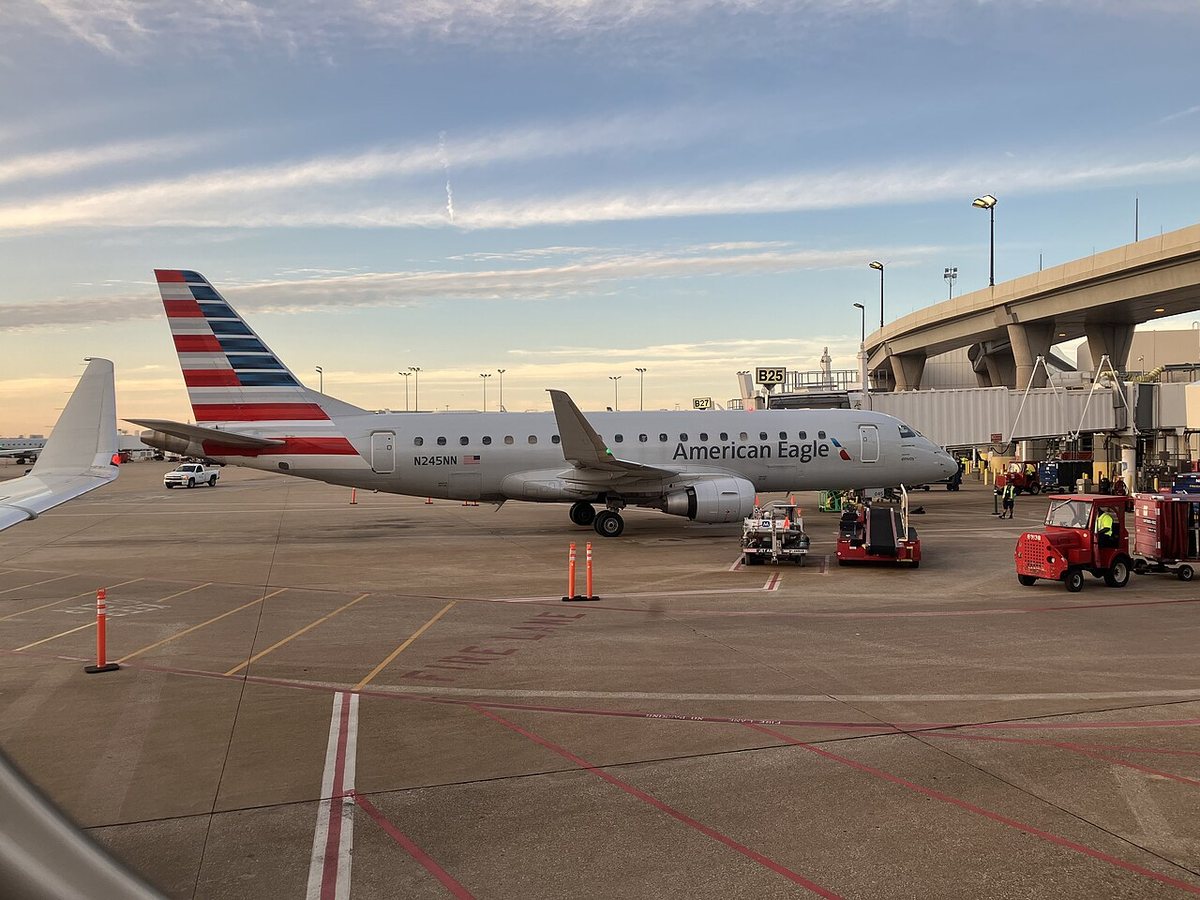
An American Eagle aircraft parked at Gate B25 at Dallas Fort Worth International Airport (DFW), where Smart Gating launched.
Photo: Designism (CC0), via Wikimedia Commons.
An arriving jet turns off the runway and heads for its gate. If that gate is still occupied, the aircraft can end up waiting on the taxiway, burning fuel while the ramp fills with traffic. American describes Smart Gating as a way to reduce those gate conflicts and get each arrival to an open gate.
| Input | What it tells the system |
|---|---|
| Flight status | When the aircraft will actually arrive |
| Aircraft type | Which gates can accommodate the aircraft |
| Runway assignment | Which direction the aircraft will taxi in from |
| Taxiway and ramp movement | Which routes and ramp space are busy right now |
| Gate availability | Which gates are open at that moment |
The tool sends each arriving aircraft to the nearest available gate with the shortest taxi time, and it decides from live data.[1] American first tested it at Dallas Fort Worth and introduced it in 2021. By 2024 it was running at five of the airline’s hubs.[2]
Live flight data picks the gate before the plane arrives
Smart Gating is American’s AI tool for gate assignment. It reads the flight’s status and aircraft type, the runway in use, the movement on the taxiways and the gates that are free, then recommends the open gate with the shortest taxi path.[3]
-
Live flight data arrives Live data
Status and aircraft type come in early, so the system knows which gates can take the arrival before it reaches the airport.
-
Nearest open gate chosen Gate choice
The system looks for the gate that is open now and sits closest to the aircraft’s arrival route, with the shortest taxi path.
-
Ground traffic checked Ramp check
The system checks taxiway and ramp movement, so the chosen path isn’t already jammed when the aircraft gets there.
-
Results tracked by hub Measure
Taxi times and ramp waits are measured at each hub, so the gains at one airport can be compared with the others.
At Washington Reagan, where ramp space is limited, American reports that Smart Gating reduced gate waits caused by another aircraft blocking the ramp by 70%.[4]
Fewer taxi hours, less fuel, fewer waits at the ramp
American reports that Smart Gating cuts total taxiing time by 17 hours a day across its system, saving an estimated 1.4 million gallons of jet fuel and more than 13,000 metric tons of carbon dioxide each year.[5]
At Dallas Fort Worth, aircraft taxi times fell by 20%, or about two minutes per flight.
Shorter taxi times at DFW · American Airlines (Nov 2023)[6]At DFW alone, American says, Smart Gating cut the time its aircraft spend taxiing by more than 11 hours a day.[7]
Rolling out one hub at a time
American adds Smart Gating one hub at a time. After the first test at Dallas Fort Worth, the company’s 2023 release named Charlotte, Miami, Washington Reagan and Chicago O’Hare as hubs running the technology.[8]
A 2025 NASA conference paper lays out a framework for predicting airport surface traffic at Charlotte-Douglas, one of the hubs where Smart Gating runs. The paper models the traffic itself; it does not measure Smart Gating.[9]
Less time on the taxiway means less fuel burned on the ground and fewer emissions, the two effects American quantifies each year.
What airline ground teams can copy
Four practical moves for gate planners, ramp teams and airport operations groups adapting live-data gate assignment.
Phase 1 · Before the Aircraft Lands
-
Decide the gate from live flight data
Data & MeasurementPut flight status, aircraft type and runway assignments into a single decision, so nobody has to piece those three inputs together by hand.
-
Count the taxi path as part of the choice
OperationsTreat the shortest taxi route as part of the assignment, since every extra minute on the taxiway uses fuel and adds emissions.
Phase 2 · Measure, Then Expand
-
Start at one busy hub with a clear baseline
Rollout & AdoptionTest at one hub, record taxi times and ramp waits before the change, then add hubs as the results hold. American’s own path ran from a first test in 2021 to five hubs by 2024.
-
Count the ramp waits, too
Data & MeasurementCount the aircraft that wait because another plane is blocking the ramp. American reports a 70% drop in that measure at Washington Reagan.
Footnotes & Sources
- Aviation Pros — Smart Gating Helps American Airlines Reduce Taxi Times (Apr 9, 2024)
- American Airlines Newsroom — Team members leverage technology to support customers this summer (May 24, 2024)
- Aviation Pros — Smart Gating Helps American Airlines Reduce Taxi Times (Apr 9, 2024)
- American Airlines Newsroom — Straight to the gate this holiday season (Nov 22, 2023)
- American Airlines Newsroom — Team members leverage technology to support customers this summer (May 24, 2024)
- American Airlines Newsroom — Straight to the gate this holiday season (Nov 22, 2023)
- American Airlines Newsroom — Straight to the gate this holiday season (Nov 22, 2023)
- American Airlines Newsroom — Straight to the gate this holiday season (Nov 22, 2023)
- NASA NTRS — A Neural-Queuing Approach to Modeling Airport Surface Traffic at Charlotte-Douglas International Airport (AIAA AVIATION Forum, July 2025; conference paper)