Fresh bread is made today and wasted tomorrow
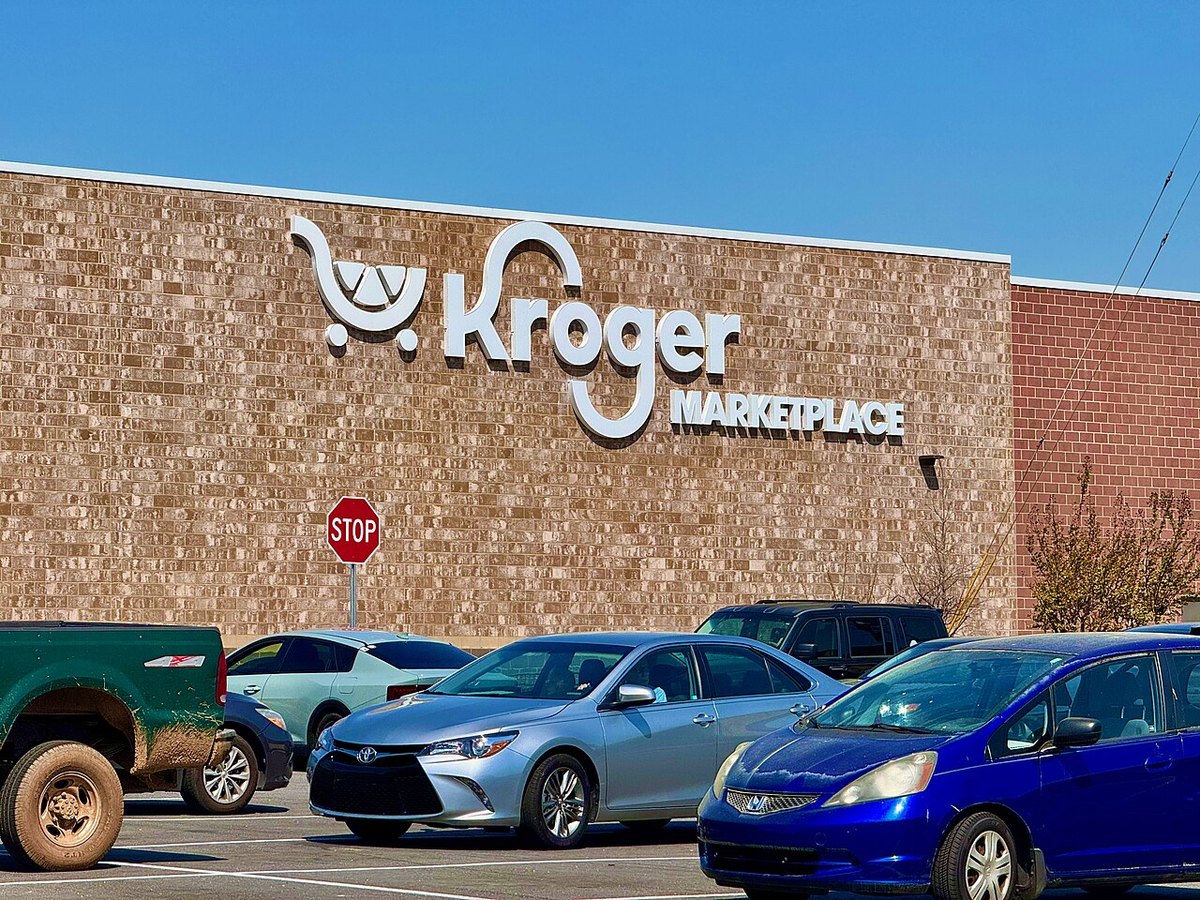
Exterior of a Kroger Marketplace store, part of Kroger’s U.S. grocery network scaling item-level smart tags in store bakeries.
Photo: Harrison Keely (CC BY 4.0), via Wikimedia Commons.
The screen says the item is on the shelf. The shelf is empty. Retailers call that phantom inventory, and a bakery case is one of the hardest places in a grocery store to avoid it. Items are baked in small batches, shelf life is short, and a count done by hand is out of date within the hour.
| Difference | Smart tags (Kroger approach) | Counting by hand |
|---|---|---|
| How items are counted | A reader picks up each item’s radio tag | A person counts shelf by shelf |
| What the system knows | Item-level stock, with about 98% read performance | A periodic snapshot |
| When markdowns happen | Earlier, because expiry is visible per item | When someone spots the date |
Kroger announced in October 2024 that it would start in the bakery, putting a radio-frequency tag on each item. In October 2026 it reported what the bakery pilot had shown, at an investor day that placed technology and AI inside its plan to modernize how stores operate.[1][2][3]
Tags give the signal, AI says where to act
Mark Ibbotson, Kroger’s chief store operations officer, put it plainly at the company’s Investor Day: “RFID gives us a better item signal. AI combines with that sales, inventory, and sell-through data so teams can see the risk earlier and act.”[2]
-
Tag the item Smart tags
Each bakery item carries a radio tag, so a reader can count what is on the shelf without touching it.[1]
-
Read the shelf ~98% read
Kroger reports about 98% read performance in roughly 1,500 store bakeries, so stores get trusted item-level counts.[2][4]
-
Combine with sales and sell-through data AI tool
For its broader waste plan, Kroger’s AI tool pulls together about 20 data pipelines and flags sell-through, no-sales, out-of-stock, over-delivery and margin risks.[2]
-
Send the flag to the right person Store team
The flag lands with the merchant, the field team or the store, who decide on a markdown or a restock.[2]
The Shelby Report adds that the same connected-store approach can route in-stock issues to the right person for a quick fix.[5]
Half the waste, faster counts, more sales
Kroger calls the bakery a pilot showing what this looks like in one department. Its pilot observations: 50% lower waste and nearly 70% faster inventory counts, helped by earlier markdown and expiration decisions.[2][4][6]
Halving waste in a department that bakes fresh every day means less product reaches the point where it has to be marked down or thrown away.
Waste 50% lower in the bakery pilot · Kroger Investor Day, 20 Oct 2026Ibbotson summed it up: “less counting, better information, lower waste, higher availability, and of course, more sales.” Kroger says better inventory confidence reduces phantom inventory and helps customers find what they came in for.[2]
From the bakery case to a connected store
A February 2026 preprint studying a major European grocer, across more than 1,700 products and 676 stores, found that demand forecasts for discounted perishables tend to run below actual sales, which points to the value of measuring those markdowns more carefully.[7]
Kroger’s broader waste plan targets about $500 million in savings by 2029, and it expects tags in more than 2,300 stores by then.[2]
Walmart is using radio tags in meat, bakery and deli.[8] Albertsons has rolled AI replenishment across its bakery and deli departments.[9] Albert Heijn reports about 815,000 kilograms of baked-goods waste avoided in the second half of 2025.[10]
What peer teams can copy
Four practical moves for grocery operations teams that want fresher shelves and less waste.
Phase 1 · Get a Trusted Item Signal
-
Pilot item-level tracking in one department
OperationsKroger began with the bakery, where shelf life is shortest and the payoff from better counts shows up fastest.
-
Measure read performance before relying on it
Data & MeasurementTrack the share of items the system reads correctly. Kroger reports about 98% in its bakery pilot.
Phase 2 · Turn the Signal Into Action
-
Tie the signal to markdown and expiry rules
AI & Workflow DesignEarlier markdown and expiration decisions are part of how Kroger reports its 50% lower waste, so build them into the routine.
-
Send each flag to a named owner
Customer & FrontlineRoute every alert to the merchant, field team or store that can act, with the item and the reason attached.
Footnotes & Sources
- Avery Dennison — Avery Dennison expands RFID adoption in grocery retail industry (22 Oct 2024)
- The Kroger Co. Investor Day corrected transcript, FactSet CallStreet (20 Oct 2026), pp. 16–18, Mark Ibbotson, EVP & Chief Store Operations Officer
- Kroger Investor Relations — Kroger Outlines Plan to Build America’s Favorite Grocer and Introduces New Long-Term Financial Targets (20 Oct 2026)
- Grocery Dive — Kroger taps RFID, computer vision data to boost inventory management (Kelly Stroh, 4 Nov 2026)
- The Shelby Report — Kroger’s ‘Connected’ Store Puts Robots, RFID and AI at the Center of Operations (2 Nov 2026)
- Supply Chain Dive — Kroger taps RFID, computer vision data to boost inventory management (Kelly Stroh, 27 Oct 2026)
- arXiv:2602.04464 — Winkelmann, Elbracht, Brenker and Gerzen, Discounted Sales of Expiring Perishables: Challenges for Demand Forecasting in Grocery Retail Practice (Feb 2026, preprint)
- Walmart — Walmart and Avery Dennison collaborate to enhance freshness and increase operational efficiency using RFID (22 Oct 2025)
- Afresh — Afresh completes AI-powered fresh replenishment roll out across all Albertsons Companies fresh departments (23 Oct 2025)
- ESM Magazine — Albert Heijn relies on AI to reduce food waste in bakery department (Julie Bréda, 11 May 2026)